
 Image via lozferatu
“Plenty more where we came from. A million per droplet of the stuff of life. Keeping track of each of us would drive God insane.”
I have tried to avoid discussing major plot points, but this review does contain spoilers.
Overview
I had wanted to read some more of David Mitchell for a while after having read his amazing Cloud Atlas. This collection of six interlocking stories blends multiple genres and historical periods, but can mainly be classified as science fiction/fantasy.
Utopia Avenue is completely different, yet I was instantly drawn in by its bohemian and musical world. Unlike the fantastical and post-apocalyptic realms of Cloud Atlas, it inhabits a far more specific, ordinary world - London in the late sixties.
It tells the story of Elf, Jasper, Dean and Griff, and the formation of their titular rock band. In Mitchell’s biopic-style novel, we find the UK’s answer to Taylor Jenkins Reid’s Daisy Jones and & the Six, but it is far from redundant because of this similarity. I would recommend this book not only to fans of Daisy Jones, but fans of psychedelic rock in general.
Even in the mundane and gritty settings of Utopia Avenue, Mitchell is just as skilled at world-building as he is in his other works. This is owing to the alternating perspectives between chapters, establishing a unique connection to each of the characters. He is also an expert in immersing his readers; with cameos from David Bowie, Janis Joplin, Jimi Hendrix and even poet Allen Ginsberg, you feel as if you’re in the heart of sixties psychedelia. Structurally, the book is divided into three ‘albums’, each chapter a song off the album, and it even features whole excerpts of song lyrics. By the end, I felt like I knew the band members and could hear their music.
The lyrics themselves don’t always convey the same depth, but are humorous and entertaining at the very least (“A thief needs a fool to ply his trade / A gullible fool who’ll trust anyone / A lover needs a cure for a serious illness / A singer needs a lawyer and a gun"). Elsewhere, they are genuinely witty - “doctor, liar, teacher, leech / pusher, mystic, hack - they / crashed the gates of Paradise / I snuck out through the back.”
On a deeper level, Mitchell completely captures the exhilaration of starting a band. From jamming with complete strangers, to coming up with a name and writing the first songs, any musician or music-lover can relate to this. I especially loved the meaning behind the band name:
“‘Utopia’ means “no place”. An avenue is a place. So is music. When we’re playing well, I'm here, but elsewhere, too. That’s the paradox. Utopia is unattainable. Avenues are everywhere.”
Music is universal, and in a roundabout way, is ineffable in this lack of specificity. In choosing to set his novel in the sixties, Mitchell enforces the timelessness of the music that inspired him - from the still fresh psychedelic sounds of Cream, Donovan, and Jimi Hendrix, to the softer folk-rock of Sandy Denny and Fairport Convention.
“In fifty years, or five hundred, or five thousand, music will still do to people what it does to us now.”
Even now, in the age of vinyl-revival, all things vintage hold a strong appeal for younger generations. Commerce and trends aside, this testifies to music’s transcendental abilities.
Characters
I loved Elf’s character development - folk singer turned rock star, obviously modelled on the likes of Sandy Denny and Joni Mitchell. Abandoned by her boyfriend and musical partner, Elf’s relationship with the band is one of mutual transformation; she elevates the initial trio out of mediocrity, and is liberated in the process.
Through Elf, Mitchell portrays someone on a “long walk out of the closet”, slowly discovering parts of herself and her sexuality. She also narrates the very heartwarming epilogue set fifty one years later. Her discussion of contemporary political issues, as well as the technological innovations that help the band regroup, demonstrates a fluidity between timelines while retaining authenticity.
As the book’s main narrator, Dean brings an endearing humour to the book as someone who doesn’t take themselves too seriously. We find him risking eviction after being scammed, kicked out of his first band, and fired from his job; he is someone who desperately needs the band without even realising it.
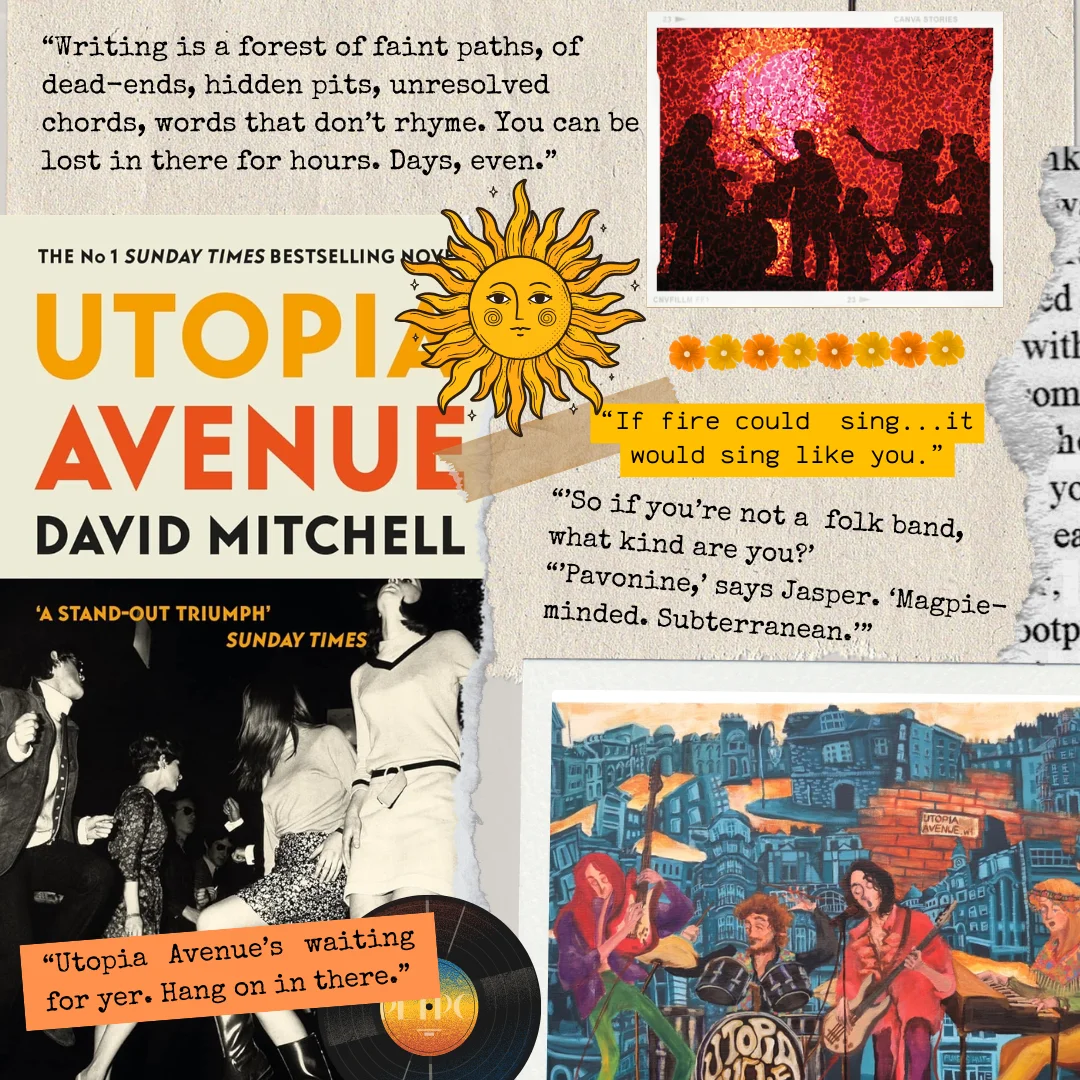
“You’ll be ripped off, mugged, and shat on, but Utopia Avenue’s waiting for yer. Hang on in there.”
Through Dean, the band comes to symbolise an unlikely hope arriving when you most need it. As someone who is also in a band named after a street - albeit a real one - this was one of my favourite quotes from the book. Being in a band on any scale is such an exciting endeavour, and I wish I could tell my younger self that “Innovation Way’s waiting for yer". (@innovationwayband on Instagram, BTW...).
Jazz drummer Griff’s most distinguishing feature is his northerness. Originally from Hull, Griff offers a northern charm and some much needed stability to his bandmate’s lives. On the one hand, his characterisation did feel a bit lazy in comparison to the others; he was the only one with no real backstory or complex issues. On the other, if his role was simply to sit back and observe, while providing comic relief and a steady rhythm for the narrative, Mitchell definitely achieved this.
Guitar virtuoso Jasper was my undoubtedly favourite character. Two things stand out about him: his approach to songwriting, and his struggles with mental health.
He is arrogant yet lovable in a very Bob Dylan-esque way, and has the same kind of elusive nature.
When Jasper says,
“We’re not gods, but we are channels for something that is god-like”
his earnestness could easily go amiss. Utopia Avenue is of course set against a backdrop of psychedelic drugs and unadulterated hedonism - an age in which it seemed very possible that gods were being channeled through the airwaves. Indeed, some of the music of that era is so unbelievably good, it must have been touched by something holy.
Furthermore, when asked what kind of music he makes, Jasper’s response is simply: “Pavonine [...] magpie-minded. Subterranean.” This refusal to categorise his music reminded me of a press conference, in which Dylan discusses his departure from traditional folk:
“I don’t play folk rock [...] I like to think of it more in terms of vision music.”
Dylan was famously difficult in interviews, as exemplified by his smug expression, and his equivocal answers bordering on the pretentious. However, this arrogance also represents a defiance of the labels journalists seem so desperate for. After all, to quote Jasper - “why stick labels on the moon? It’s Art?” Amid all his snobbery and self-importance, there are sentiments that ring true.
While coming from an aristocratic background, Jasper is disowned by his family. He suffers from schizophrenia, and experiences auditory hallucinations referred to as “knock knock” throughout the book. His characterisation not only explores mental illness and neurodivergence in a time period that lacked understanding, but also leads the book in a more surreal direction.
After doing some research, I found that there are links to some of Mitchell’s other books (The Bone Clocks, Cloud Atlas). Mitchell makes a lot of references that can go over your head a bit if, like me, you’re not familiar with his complete works. This worked for the most part, adding a mystical flair to the narrative. At one point, though, it got a bit much.
For just one chapter, Jasper’s hallucinations completely take over, and then are magically resolved. Historical fiction blends with magical realism in a way that was simply out of place. It felt over-indulgent, and in a way undermined a lot of Jasper’s struggles. I am a fan of magical realism, but the sudden and brief genre shift half-way through was superfluous.
Other than that, I thought this book was wonderful. While it deserves its own merit, I would highly recommend it to anyone who read Daisy Jones and wants something similar. It is a testament to song-writing, love, music and friendship, and speaks to Mitchell’s skill and range as a writer.