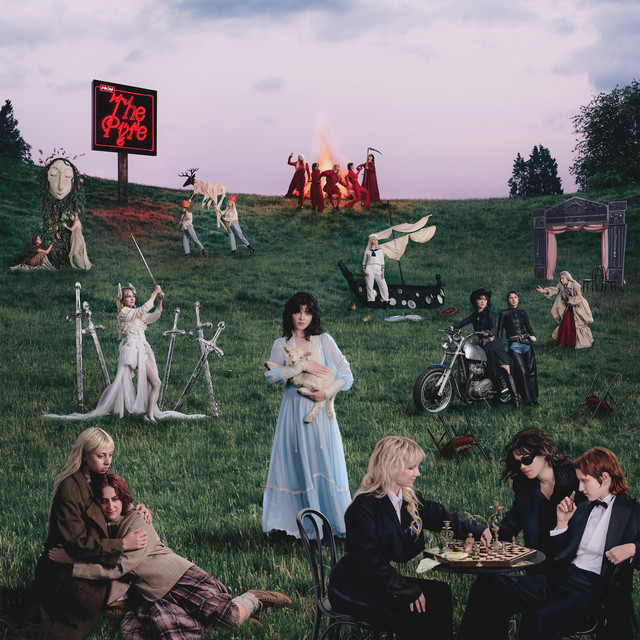
 Source: Spotify
Since watching Jane Schoenbrun’s 2024 film I Saw the TV Glow and witnessing King Woman’s electrifying cameo, I have been obsessed with their song ‘Psychic Wound’. Only recently, however, have I delved into their whole discography, and I've been hooked.
Originally Kristina Esfandiari’s solo project, King Woman has evolved into a full band over the years. Their 2017 debut album Created in the Image of Suffering showcased a unique soundscape of shoegaze, doom-metal and grunge. Returning in 2021 with Celestial Blues, King Woman harnessed a much sharper sound, blending their signature stoner doom with lighter sounds to create something completely mystical and enveloping.
Written entirely by Esfandiari, the nine tracks continue exploring her intense Christian upbringing. The frontwoman has previously described wanting to leave her past behind, and the album became integral to this process:
Celestial Blues is a complex and deeply personal album, and encompasses a range of themes besides religion. The English student in me couldn't help but interpret it through a literary lens, however. What drew me to the album was its allusions to John Milton’s Paradise Lost, and it took me back to an essay I wrote back in second year. Intrigued by the surveillance and power dynamics within Milton’s Eden, I wanted to explore how Satan undermines its idyllic appearance with promises of enlightenment and freedom. Similarly, Esfandiari creates a world that is dark and oppressive, exposing everything from religious abuse and trauma, to the burden of eternal damnation that can dominate faith. Through the character of Satan/Lucifer, she challenges these endlessly regurgitated narratives that one eclipsed her life.
The Fall
The title track wastes no time foregrounding lots of fundamental imagery. A spoken word section sets the scene, inspired by seizures or ‘blackout periods’ Esfandiari would have as a child and setting the tone for the chaos that follows.
We are told that “the devil left a bruise”, whereas God offers salvation through the words “take my hand/ let’s go to the land.” Here, Esfandiari is setting up traditional ideas that contrast satanic abuse with divine protection. There is also an element of being enticed with false promises; as she follows, she inevitably sacrifices part of herself.
“But my life is no longer mine once I recite
Shrill noises from a crypt.”
These lyrics convey a loss of identity, repeating words that not only belong to someone else, but are void of meaning - as if from a burial ground. It is reminiscent of Milton’s Adam and Eve; God forbids them from eating the fruit purely to “keep [them] low and ignorant.” They are happy enough in their edenic bliss, but remain powerless in their lack of knowledge, unable to question who they are. The nature of their happiness is fragile, dependent only on their compliance and fear, as epitomised in this quote from Eve:
“How are we happy, still in fear of harm? [...] frail is our happiness, if this be so, And Eden were no Eden thus exposed.”
Her argument is compelling, and we sympathise with her as a fugitive in a world that forbids knowledge. When free will is compromised, the whole concept of Eden is undermined. With this in mind, then, we can see in Esfandiari’s narrator someone who is searching for their identity. As the song builds, she goes on to describe “looking for a home [...] that doesn’t exist,” evoking the recognised archetype of the fallen angel.
Esfandiari has often spoke about the Charismatic Christian church she grew up in, and the beliefs that were so widely accepted as facts: "They believed in exorcisms and demons and angels [...] and I had exorcisms performed on me as a child. So, I was bombarded with these stories, and they’re told to you as if they’re fact and truth, and it’s scary."
For her, it was not enough to simply believe in something; fear was a key component, much like the fear instilled into Adam and Eve. These narratives - the Fall, Original Sin - and subsequently the album, centre around a pivotal moment of rejecting these 'truths'. It's about learning to question, and suffering the consequences.
“I’ve got celestial blues” thus comes to signify this feeling of being cast out of heaven, left with no direction in the abyss. Rather than simply lamenting, these lyrics contain a justified rage at being unfairly punished. They take on a destructive quality (“I want to crash my heart into the divine”), imagining tearing down heaven and all it stands for.
One repeated lyric really stands out here:
“Celestial night
They took me from my birthright."
Esfandiari begins to reshape the story of the Fall, instead framing it as an injustice done to Lucifer. ‘They’ could refer to any institution willing to reprimand those who think differently. In banishing Lucifer, God is severing him from the safety and comfort of Heaven.
The phenomenal single ‘Morning Star’ follows, taking us back to the start of Lucifer’s journey. The title refers to the angel’s Latin name, and sees him questioning what remains of his identity after his expulsion from heaven.
Often the black-and-white portrayal of Lucifer prevails - that of the serpent, the seductress, the unequivocal agent of evil. With this track, Esfandiari wanted to give Lucifer a voice: "I wanted Lucifer to tell their side of the story. But it’s also about personal experiences where I felt I was a scapegoat in a situation. And that feeling you’ve lost your mind and gone to hell, basically, and come out on the other side a little deranged or crooked and at the same time magnificent.”
Beyond the obvious definition of 'scapegoat', the word has a long history of ritualised violence. According to historian and critic Rene Girard, human desire boils down to mimesis/imitation; in other words, desires are learnt from copying those of others, rather than instinctive. This leads to rivalry and disorder, which can only be resolved by projecting the conflict onto one person and removing them from society. While famously associated with Jesus' crucifixion, this also applies Esfandiari's treatment of Lucifer. His rebellion not only suffers violent and catastrophic consequences; it becomes an example of something to never be repeated, further enforcing order through fear.
The song’s first line, “the Lord saw what He made, yeah it was good,”, is of course taken straight from Genesis. It is sung with a breathy indifference - a juvenile snarl hinting at imminent rebellion.
Lucifer remembers being “luminous” and “ascending the heights”, which is brutally undercut by an explosive chorus. Here, he asks
“Am I
Far from God?
Morning star.”
Despite the uncertainty, there is something empowering about the phrasing here. The huge existential question is preceded by the reiteration of his name - something that can never be taken away. Lucifer is now free to explore and transform into something menacingly beautiful, like his namesake.
Again, I was reminded of the ending of Paradise Lost. Milton leaves us with this final image of the exiled Adam and Eve:
“The world was all before them, where to choose
Their place of rest, and Providence their guide:
They hand in hand with wand’ring steps and slow,
Through Eden took their solitary way.”
Despite what has just occurred, these lines are undeniably liberating. Eden was only a small fraction of the world, and now the rest is open to them. We can picture the celestial night sky, and the vast earth stretching out as their entire world suddenly expands. It is the start of a journey, and has all the excitement of J.R.R Tolkien's 'A Walking Song' ("home is behind, the world ahead").
Elsewhere, Esfandiari explores the hypocrisy and double standards governing this situation in which she was scapegoated: “you know it could have been you/ so don't you dare judge the things that I do." She addresses her sanctimonious onlookers by pointing out that her weakness was something astoundingly natural and human.
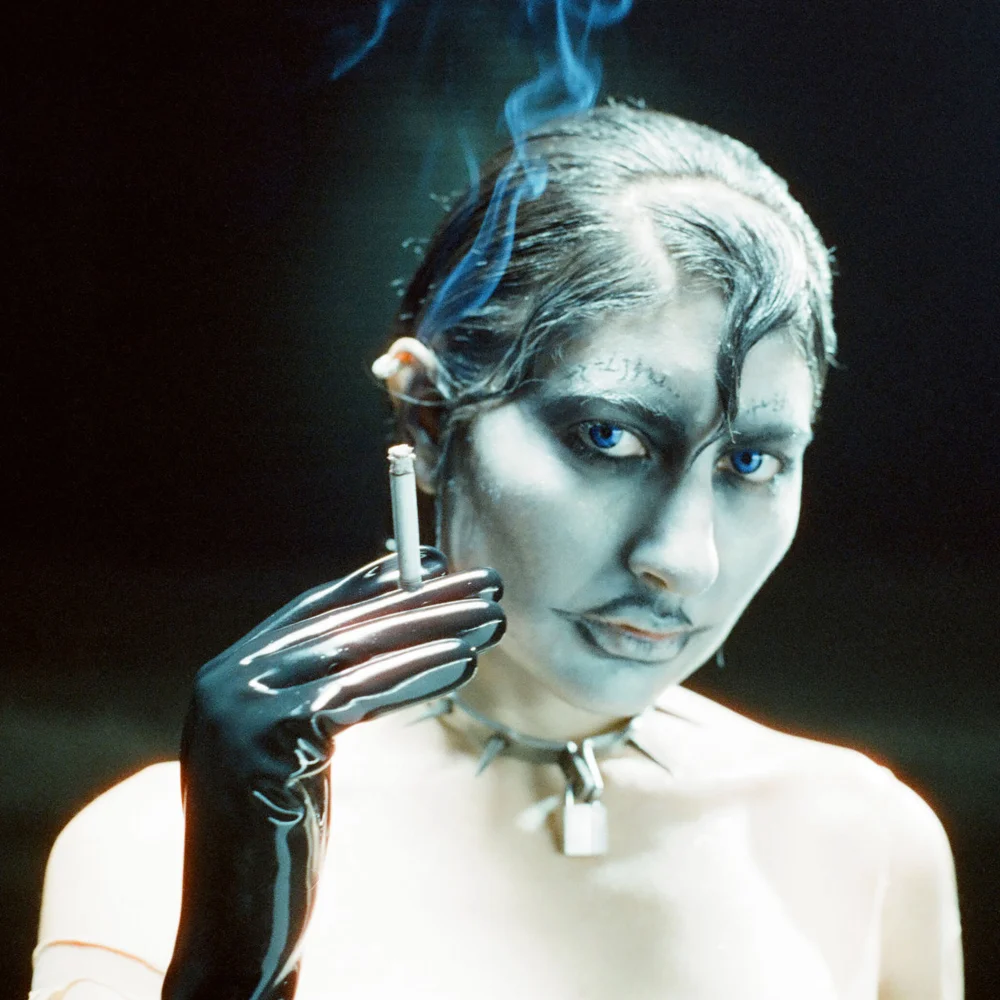
The theatrical music video only elevates this further. Shot in one take, Esfandiari dances seductively, smoke from her cigarette shrouding her. She looks terrifying in clownish, almost drag-like makeup, a nod to her own interpretation of Lucifer as “a kind of an androgynous, Joker type of character.”
Source: Genius
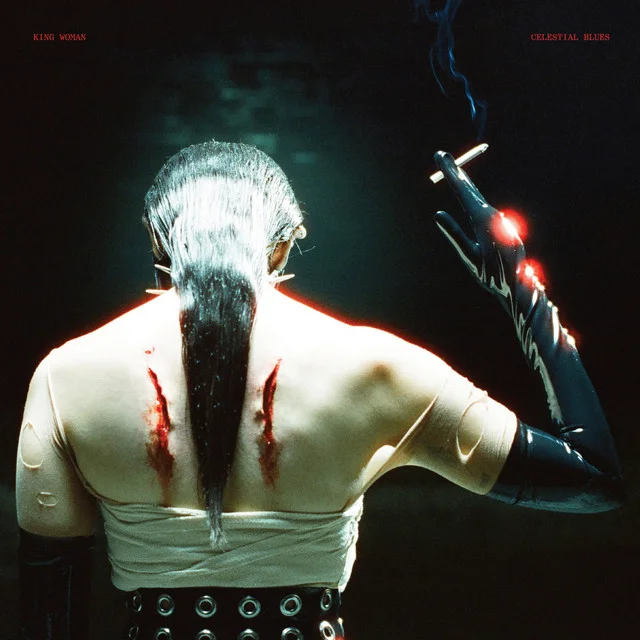
The unhinged elements of her demeanour are hard to ignore, a powerful retaliation for everything that’s been done to her. Her embodiment of the character forms the basis of the album cover, in which she is seen from behind - scars from wings mercilessly ripped from her, wounded yet triumphant.
The next song, 'Boghz', is one of the album’s most intense moments, showcasing Esfandiari's vocal range through ferocious growls. She draws on her Iranian heritage here; in Farsi, ‘boghz’ is used to describe the lump you get in your throat before crying. The song is not explicitly religious, instead focusing on a past relationship in which “the other person just kept beating [her] down and being so sadistic.” In the context of the album’s overarching religious themes, however, the song pertains to God’s relationship with Adam and Eve.
Esfandiari channels an anger in this song that is utterly captivating, closer to Eve's frustration at being controlled by the men in her life - “Here's what I'm gonna do/ Get down on my hands and knees for you.”
Again, the idea of Eden depended on its inhabitants being kept “low and ignorant”, - in other words, subordinate. Furthermore, there is an element of feeling hopeless of the face of something pre-ordained. She predicts her submissive actions with certainty and conviction, thereby removing any autonomy from it.
Esfandiari switches up the lyric “you know this isn’t love” with “you know this is a lie”. It nods to this initial attraction turning to disillusion. There is a strong fluidity in how she sings about religious tropes, to the point where they become applicable to her own romantic relationships and personal issues. Paired with the exasperation she sings with, the song emphasises her suffering.
The Snake
After posing these questions surrounding identity, the album enters a movement that is both bleak, and set ablaze by a simmering wrath.
‘Golgotha’ is a highlight for me; it opens with beautifully layered guitars, demonstrating the mastery of guitarist Peter Arensdorf.
The title refers to the place in which Christ was crucified, again cementing an ongoing cycle of scapegoating and sacrifices made in vain. The song is repetitive and has very few lyrics, and yet is so effective in its delivery.
“Never ends, no it never ends
The snake eats its tail, we return again to
This hell, this hell
I'll see you again with the skulls, my friend”
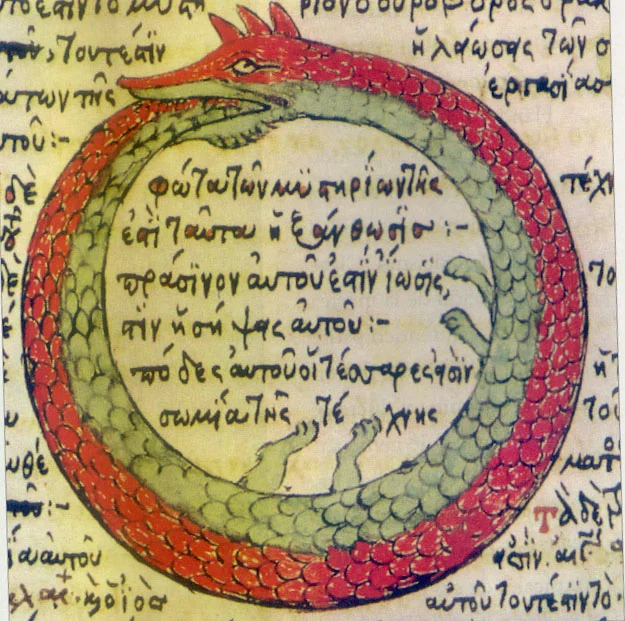
It is macabre and mantric, referring to the Ouroboros.
Source: Oxford Classical Dictionary.
This ancient symbol of a snake/dragon eating its own tail traditionally symbolises the cycle of life and death, but Esfandiari illuminates the devastating elements of this. Her snake signifies a never-ending cycle of self-destruction, and a feeling of helplessness in the face of something relentless.
Esfandiari continues to viciously attack the church’s patriarchal hypocrisy in the lyrics about the Virgin Mary: “Golgotha/
I heard the Virgin is having a baby/ Immaculate Conception, can you save me?" As she discusses being crushed by a weight, she alludes to the pressures of unattainable standards for women. She longs for the stainless, inherently sin-free life Mary was graced with, as opposed to the lust that led to Eve's damnation. There are almost dissonant harmonies here, adding a disconcerting layer to this inner conflict.
The serpentine imagery continues on 'Coil', my favourite song off the album. Interestingly, Esfandiari now sings from Christ's perspective, blurring the lines between him and Lucifer by suggesting shared qualities. Whereas 'Golgotha' focuses on negative aspects of the cyclical, this is the other side - that of regeneration. It explores balance, continuation and rebirth through the snake shedding its skin.
It could also refer to an uncoiling. In Norse mythology, the Ouroboros is depicted as Jörmungandr, a serpent encircling the world; when the snake releases its tail, Ragnarok will begin. We can hear this havoc unravelling in the music. Beginning with a kind of breathlessness, it becomes increasingly frantic, spurred on by the thunderous drumming of Joseph Raygoza.
Esfandiari has discussed writing the song in response to people who have held her back from her dreams, and her eventual realisation of power - “the song is my declaration that I’m unstoppable. It’s the song of the warrior. The "infernal coil" she conjures up in her lyrics thus embodies a vengeance that will destroy everything.
“They want me gone
Well, best of luck
I've already passed
I've been raised up”
Usually it is Jesus associated with ascension; here it is Lucifer, dripping with sarcasm as he begins to ascend the heights once more. This ability to regenerate further solidifies a defiance of the scapegoat role, and reconfigures the Fall as something transformative. Indeed, the fallen angel begins to love the parts of himself that once were punished ("blessed be the curse in me/ I feel the joy in everything").
There is certainly something gleefully deranged as the music becomes more cacophonous. Esfandiari screams
"Five wounds to take me
Five wounds had me dead
Five wounds you raped me
But I resurrect,"
reclaiming the 'birthright' mentioned at the very beginning.
The Saddest Story
Reaching the end of the album, the narrative wraps up with one final burst of energy. ‘Psychic Wound’ is a song I’ll always love, as the one that introduced me to King Woman. The opening guitar riff is so ominous and addictive, fitting for a song about a dangerously enticing "luscious fruit". At its core is the feeling of being chained to someone far more powerful than yourself, returning to ideas of Lucifer as "seductive" and a "sulphurous possessor".
Esfandiari sings of being "enslaved by opinions", again referring to the beliefs that were ingrained in her as a child. It can also be misheard as "enslaved by the pinions"; with Lucifer’s torn wings in mind, she was trapped by the life forced upon her.
The seductive elements of the song are a testament to how flawless Satan's argument is. As Esfandiari sings "why have I been punished?/ I've been banished from the sky," it corresponds to an interrogative moment in PL:
“ye shall not die:
How should ye? By the fruit? it gives you life
to knowledge.”
Here, Satan is explicitly questioning God's logic in keeping them away from the Tree of Knowledge - he calls it "suspicious" and "reasonless", since knowledge is what makes us human. The syntax is also crucial here, with the line ending just after ‘life’- the fruit is not only enlightenment, but a life source. If knowledge is the key to life, how can it be a sin?
The song is overshadowed by the suffering and guilt that comes with giving into these desires, and above all the question of why it is so wrong.
'Psychic wounds' typically refer to something that happens in childhood, from which the person never truly recovers. Esfandiari screams in chopped rhythms about these wounds before spiralling into a frenzied and gut-wrenching outro, as if exorcising this internal trauma.
The final track finds Lucifer back where he started. 'Paradise Lost' is a gloomy ending to such a fiery album, but reiterates its overall message - that the real sin was done to Lucifer, not by him. The title explicitly refers to Milton and the irrevocable loss of Eden.
"We have been thrown from Eden
I need to find the maker
You're gonna blame it on me
It's just the saddest story."
Lucifer has been a scapegoat from the beginning. Like Adam and Eve, he was cast out into a cold, harsh reality by a seemingly all-loving father. Ending with this idea of disconnect, there is a total lack of closure.
While I admit 'Coil' might have been a more emphatic ending to the album, maybe that is the point. 'Paradise Lost' is unusually mellow and contemplative, portraying an exhausted Lucifer who has nothing left to give. As in 'Coil', however, there is always the possibility of growth. Esfandiari sings about needing a place to grieve, and ultimately that is what the album is for her: a place to inhabit these oppressive worlds, to destroy and reshape them.