 Source: NME
Throughout the post-punk revival of the 2000s, many British bands rode its waves to create a nervy and literate indie rock sound - be it freshmen Arctic Monkeys’ Sillitoean chants and The Jam-esque guitars, or the already established Radiohead combining Orwellian politics with fairytale imagery, underscored by an ambient post-punk sound. Among the many, one band stood out: Bloc Party. Formed in London in 1999, these 4 misfits had just as big an affinity for the dark gothic introspect of Joy Division and Siouxsie and the Banshees, as well as the playful and artsy nature of Talking Heads and The Police, as their peers.
Silent Alarm, their debut album, utilised all these influences. Thanks to Paul Epworth’s masterful production, which incorporated elements of electronic music and R&B, Bloc Party created the most ambitious indie rock record of the 2000s. However, despite appealing to the same studded belt teens who loved The Strokes and Razorlight, Bloc Party didn’t fit in with their peers.
Music
The first thing that stands out about the overall sound of Silent Alarm is the album's focus on strong percussion. Their often unorthodox production techniques immediately capture listener’s attention; whether it’s the gargantuan drums of opening track ‘Like Eating Glass’, and Epworth's intentionally mixing of Matt Tong’s drums to be louder, or the militant march of ‘Price of Gasoline’, made through bassist Gordon Moakes walking into the studio with planks of wood strapped to his feet. These percussive elements were all created through a combination of sound effects, and Tong alternating between high and low intensity when writing drum parts. The drummer has spoke about how his smoking habits affected the album:
“In fact, the very first rehearsal I did with that band, I had to stop between every song, roll a cigarette and just sit there smoking. And so a lot of that playing was informed by the fact that I'd get really tired — so I'd try and change the parts a bit, and write something that felt different and less intense. That's why the drum parts kind of evolve, or are so scattershot, throughout that record.”
Despite this, the drum arrangements in the album are characterised as high energy and groove-focused. In particular, the palpitating rhythm of ‘She’s Hearing Voices’ employs a very strong dance groove.
Tong’s drumming doesn’t stand alone though - it’s complimented by the work of Gordon Moakes on bass. While it playfully jumps along with the drums in ‘She’s Hearing Voices’, there is a wide variation in his minimalistic, melodic playing, akin to The Smith’s Andy Rourke and Joy Division’s Peter Hook. This approach is showcased through the infectious disco groove on ‘Banquet’, the frantic punk-influenced chugging on ‘Helicopter’ and ‘Luno’, and the melodic lines in the climax on ‘This Modern Love’.
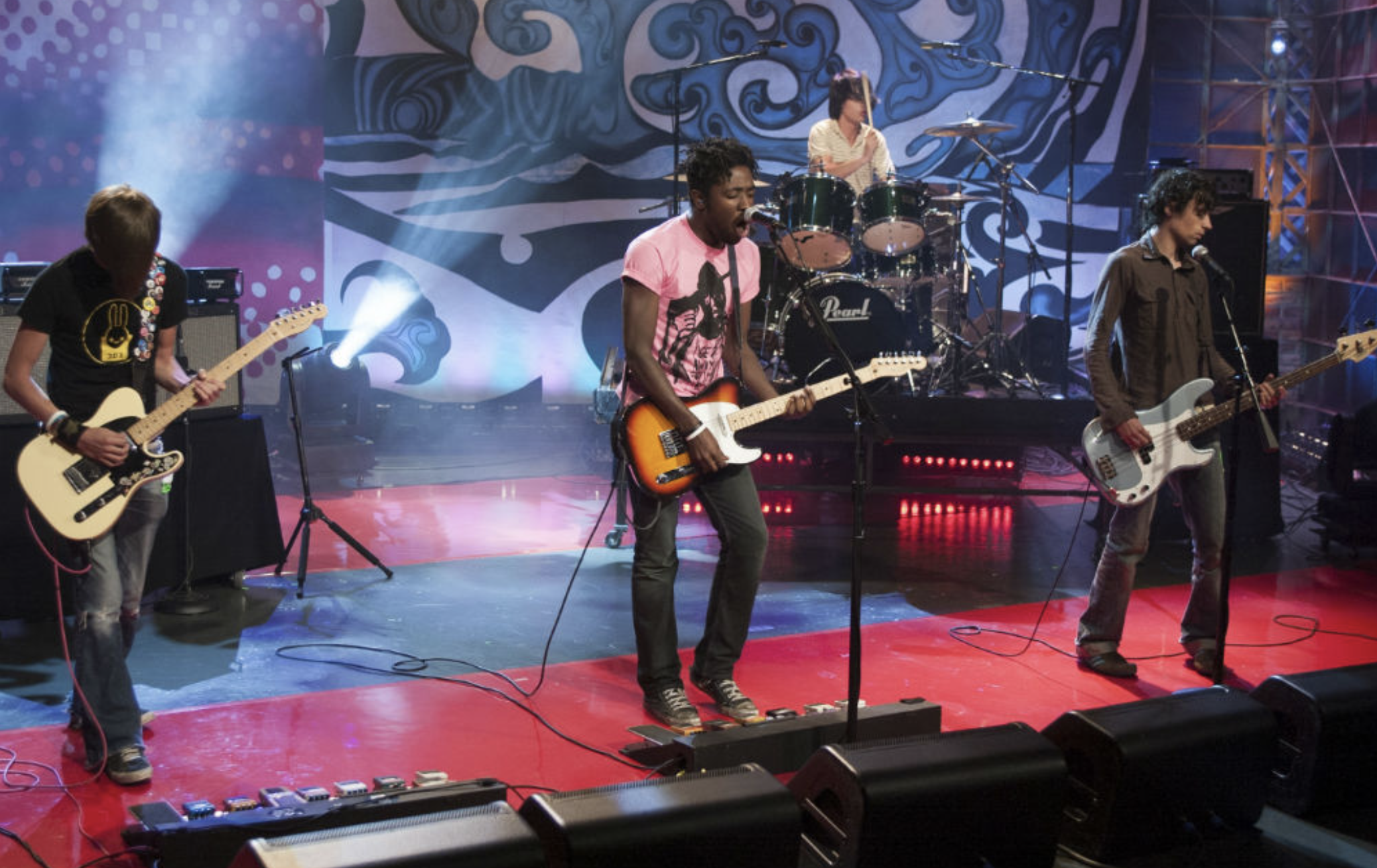
The synergy of Kele Okereke and Russell Lissack’s guitars is probably the defining factor in the early sound of Bloc Party, defined by razor sharp lines and a compendium of effects. Like their guitar heroes Blur and Radiohead, their sound is heavily concentrated through their use of Fender Telecasters. This enables them to switch between the overdrive in the cathartic exit of ‘Like Eating Glass’, and their preferred clean, jangly textures in ‘So Here We Are’ and ‘Blue Light’:
“I think they were scared of even using distortion pedals, because they were really into this chiming, clean guitar sound. But they gradually realised that you have to shape dynamics a bit more subtly." - Epworth
While other guitar groups like The Strokes and The Libertines had assigned rhythm and lead guitar roles in their songs, Bloc Party sees both guitarists battling for the lead position. This can be heard through the twofold guitar riff and harmonic solo of ‘Helicopter'. However, there are occasions where Okereke takes on the traditional rhythm guitar role, such as the call and response used in ‘Banquet'.
The album's use of effects pedals is another feature that distinguished Bloc Party from the indie scene of the 2000s. Many bands kept it minimal, using only distortion and reverb, but Bloc Party used various effects to create a sense of ambience. This is heard in the delay on ‘The Pioneers’, the ethereal walls of sound on ‘She’s Hearing Voices’, and the tremulous flange on ‘Plans’.
Lyrics
Despite Silent Alarm not containing a specific lyrical centre, it’s safe to say three main themes emerge: youth disillusionment, innocence and cultural politics. This doesn’t come as a surprise given the political climate in which it was produced and written; post-9/11 anxiety amidst the War on Terror, social and economic strain and widespread public apathy. Okereke, who studied English Literature at King’s College, London, was inspired by the confessional poetry of Anne Sexton and Sylvia Plath, as well as bands like Radiohead and The Smiths in writing:
“Then I really got into the Smiths. The lyrics were amazing, so focused. There’s no worse sin as an artist than hiding between cliches and abstractions. If you have something to say, it should be able to be understood by everyone."
The opening track ‘Like Eating Glass’ is evident of the poetic influences on the band, through the repeated line "we’ve got crosses on our eyes”.
This line, inspired by cartoon characters having crosses on their eyes after they die, creates a jagged image of a childhood metaphor, while also conveying feelings of a failing relationship. ‘Positive Tension’ explores youth disillusionment through boredom, and how it leads you into dangerous places. ‘Banquet’, on the other hand, concerns sexual desire, highlighting the cannibalistic nature of love portrayed in David Madsen’s 1997 novel Confessions of a Flesh-Eater:
“I wanted to bite, not to destroy, to feel her underneath”
The more political songs, which Moakes contributed lyrics to, directly mirror the circumstances that Silent Alarm was written and produced under. The discussion of ‘red states’, consumerism and fear of ‘the Other’ appears in ‘Helicopter.' ‘Price of Gasoline’, written in response to the Iraq War, mocks the US propaganda through the jingoistic chant (“War! War! War! War!").
Similarly, ‘The Pioneers’ satirically depicts a clueless West, who have become overconfident in their ability to ‘civilise’ the rest of the world, until the chorus makes it obvious that they don’t know how to (“We promised the world we’d tame it / What were we hoping for?”).
The final extension of the band’s literary influences is the use of character studies, which also demonstrates the Britpop influences they sought to be rid of. However, their characters are no ‘Tracy Jacks’. The highly medicated schizophrenic in ‘She’s Hearing Voices’ is terrified to the point of racism (“She’s scared of the blacks and she’s scared of the Jews").
‘Luno’ is about a teenage girl whose parents contribute to her increasing insecurities. She consequently destroys herself to become beautiful, possibly through substance abuse:
“And your nose is bleeding (You deserve it)/ And your nose is bleeding (You deserve it)/ You’ve been lying to me”
Despite Bloc Party not matching the rugged male bravado of Razorlight's Johnny Borrell, the swaggering detachment of Julian Casablancas, or the sounds of their Britpop predecessors, Silent Alarm remains one of the most groundbreaking albums of all time. Their sophomore album A Weekend in The City continued to explore themes of youth and politics, expanding on electronic elements while still preserving the band's legacy as indie-rock legends.