 Image via lozferatu
TW: this review contains mentions of suicide and cancer
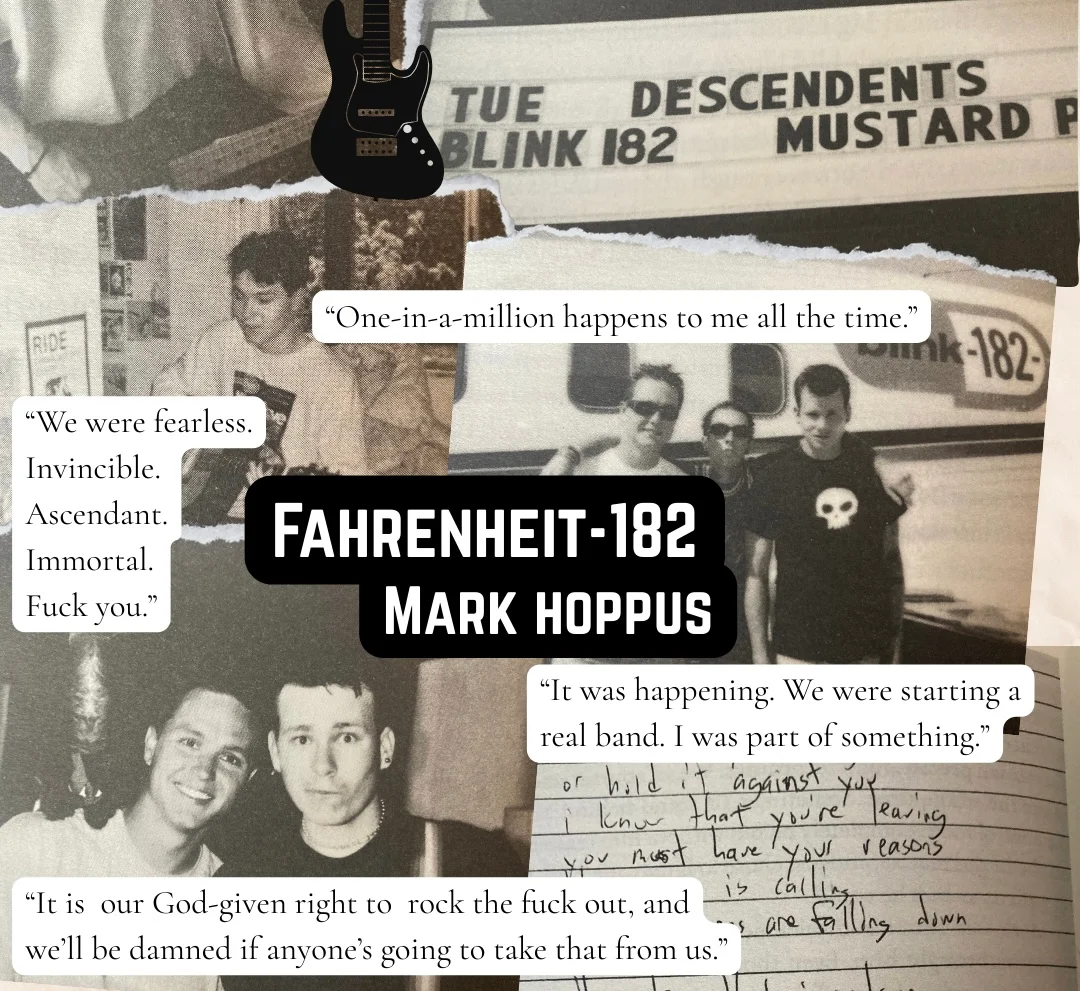
Mark Hoppus’ Fahrenheit-182 was something I’d looked forward to reading for months, and I was not disappointed. I’d originally bought the book to read on holiday last summer, but I couldn’t wait and had devoured it by the time I was there. Co-written with music journalist Dan Ozzie, the memoir offers a comprehensive history of blink-182, from their humble origins in the So-Cal punk scene, to their accidental becoming a mainstream 'pop' band.
The founding member and bassist's prose is similar to his lyrics - no bullshit, just earnest and refreshing writing littered with childish jokes.
He begins by recalling his childhood in the Californian desert, and many moments stand out as being formative for both him and the band; watching comedian George Carlin, who’s famous ‘seven words you can’t say on television’ became 'Family Reunion'; witnessing his parent’s divorce, which became 'Adam’s Song', and picking up bass for the first time (“Fuck. Yes. Excalibur in my hands.”).
Hoppus leaves nothing out of blink’s journey. He recounts the arbitrary addition of the -182 following a near lawsuit, various mispronunciations (is it one eight-two or one eighty-two?), and everything that culminated in them being labelled the 'naked band'.
Before any of this fame, however, blink were a band who worked really hard towards their goal. Hoppus describes their DIY approach to the music industry not as an aesthetic, but a “necessity”, which shines through in his stories of playing seedy clubs and assembling his own cassette tapes.
He takes us all the way back to 1995, and the recording of their first studio album Cheshire Cat. There is something so raw and chaotic about the album. On the name and cover art, Hoppus explained his love for the Alice's Adventures in Wonderland character:
“He’s unknowable, he’s here and then he disappears. He says weird shit. He’s The Fool of both Shakespeare and tarot.”
It also epitomises his own character; though he has changed as a musician since then, that maverick spirit is unshakeable. This was the start of his fool's journey, and it can be heard in the potent juvenescence of the album.
blink eventually signed to MCA Records in 1997, and went on to enlist the legendary drummer Travis Barker. In these sections, Hoppus candidly navigates the tricky relationship punk has with major labels: “It was punk rock’s forbidden fruit, akin to selling your soul to the Devil.” Selling their souls, however, meant having the courage to run down the streets of Los Angeles fully naked, which is arguably very punk rock.
One of my favourite things about Fahrenheit-182 is the way Hoppus describes his friendship with guitarist Tom Delonge. “I loved Tom from the first day I met him,” he writes about that pivotal moment in which goth kid met skater boy. Over the years their musical partnership has been tempestuous, Hoppus’ grounded nature often at odds with DeLonge’s extra-terrestrial ambitions - ultimately, this is why they work so well together as songwriters. While Delonge is always chasing something huge and anthemic, Hoppus strips everything back to its purest form. The two always meet in the middle with their humour, with Hoppus aptly naming them the “Lennon and McCartney of dick jokes.”
He perfectly captures the joys of being in a band with your best friends - starting from nothing, and having that magical moment when everything falls into place. For him, this was playing blink’s first song ‘Carousel’ in Delonge’s garage: “it sounded imperfect but we were imperfect together.”
That being said, Hoppus does not shy away from the gritter aspects, detailing their multiple breakups and reunions. People have a tendency to think of blink simply as a joke band, but their 2003 self-titled record was a huge departure from this. There was a lot of tension at the time; Delonge was suffering a lot of back pain due to a herniated disc, and subsequently began to pursue another musical project called Box Car Racer. Bringing Barker along with him further caused a huge rift within the band. They could hardly go back to being the goofy nudist trio, and the result was something much darker, somewhere between pop-punk and post-hardcore/noise-rock.
The project was an immersive and all-consuming one, with the band renting a house to write and record the album. Producer Jerry Finn was invaluable, using old school gear and production techniques, such as building a reverb chamber in the shower. Hoppus and Delonge found ways to adapt to their new musical differences, writing parts in opposite rooms then piecing them together to make a song. It allowed the band to really push themselves into new genres, creating some of their best music in the process.
Fahrenheit-182 is not just a memoir about music, though. It is highly emotional at times, and I appreciated its darker moments. Hoppus quite literally alternates between dick jokes and sardonic wit:
“Yes, I’m laughing and having the time of my life, but I’ve also wondered how much blood my bathtub holds.”
He discusses his ongoing struggles with OCD and depression, as well as his recent battle with cancer. Amid this difficult chapter, the Mark, Tom and Travis show managed to reunite, releasing their ninth studio album One More Time… in 2023. The main single of the same name features the lyric
“it shouldn't take a sickness
Or airplanes falling out the sky,”
a nod to Hoppus’ and Barker’s respective near-death experiences.
As expected, mixed in with Hoppus’ story are hilarious anecdotes, involving his one line in American Pie, as well as the time when Robert Smith of The Cure tried to make out with him. He also makes some completely audacious claims, taking credit for Green Day’s American Idiot, and the U.S. government’s capture of Saddam Hussein.
His humourous and (mostly) down-to-earth writing style made this a pleasure to read. Including lyric sheets and unseen pictures, it’s a must-read for any die-hard blink fan. Hoppus is the Cheshire Cat of punk rock, never taking himself too seriously, and always grinning with bass in hand. And yet, he never misses an opportunity to express how grateful he for his band, friends and family, as seen in the closing quote:
“My best friends follow me onstage. A thought crosses my mind. Maybe I died in that cancer centre and this is heaven. I step out into the light and noise.”