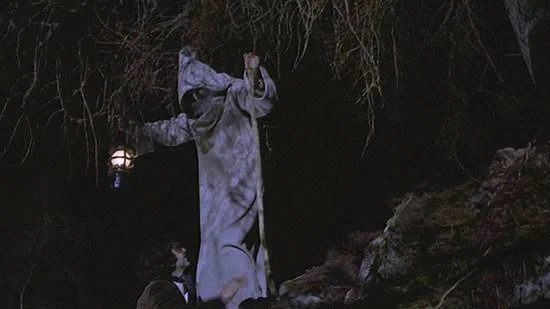
 Source: The Song Remains the Same
You don't have to delve too deep into Led Zeppelin's discography to find their affinity with high fantasy and all things mythical.
Robert Plant was a huge fan of J.R.R Tolkien, even naming his dog Strider after the character Aragorn, and this is evident in his lyrics. His love for fantasy and rural England culminated in a kind of lyrical pastoralism, that has since set apart his writing style in the world of rock and roll. In contrast to this, Jimmy Page's interest in occultism was a lot darker, and defined a huge part of the band's aesthetic at the time.
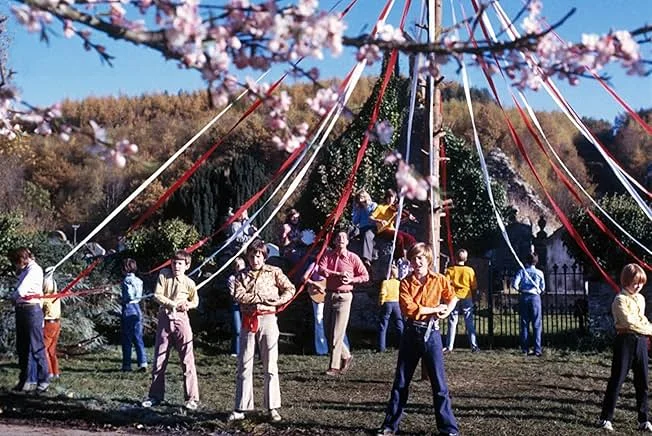
In light of May - a month rich in folk traditions - coming to an end, I wanted to explore some of the Celtic and pagan folklore that inspired one of my favourite bands, while entering the fantasy realm constructed by the band itself.
Following the success of Led Zeppelin I and Led Zeppelin II, the band had already devised their own brand of rock and roll mythos only two albums in. Their third studio album (unsurprisingly titled Led Zeppelin III), took things in a different direction. Amid the whirlwind of commercial success and touring, the band decided to retreat to Bron-Yr-Aur, a cottage in Snowdonia, and begin writing their next project. Welsh for 'golden breast', the name subsequently became the title of two Zeppelin tracks, encapsulating these rural lands and the tales they contained.
The tranquility of the Welsh landscape, as well as its lack of electricity and running water, encouraged a more acoustic, folk-oriented sound. While still honing their gargantuan, stadium rock on 'Immigrant Song' and 'Celebration Day', songs such as 'That's the Way' and 'Tangerine' signalled an acoustic mysticism finding its way into their canon.
The Celtic and pagan influences became explicit in later albums, but LZ III was pivotal for the band's thematic and musical direction. Below is a collection of Led Zeppelin tracks that, whether lyrically or visually, delve into their love of myth and folklore.
'The Battle of Evermore'
This Celtic folk saga is off the band's seminal fourth album (can you guess the title?), featuring intricate mandolin arrangements and Fairport Convention's Sandy Denny on vocals. Its complete lack of percussion forced a more intense and eerie listening experience than previously encountered. The lyrics are allegorical, firmly pushing Plant out of his vocabulary of "baby" and "hey girl", and into more fantastical territory. 'The Battle of Evermore' depicts a battle between good and evil, something that persists from ancient folklore until present day. It is predominantly made up of references to Tolkien's The Lord of the Rings, but is also shaped by Arthurian legend with mentions of Avalon and the Battle of Camlann. The band's alchemy of mythical allusion thus results in a brand of storytelling unique to them.
"The Queen of Light took her bow
And then she turned to go
The Prince of Peace embraced the gloom
And walked the night alone."
These opening lines focus on the character of Galadriel, taking up her bow to signal the coming of the Age of Men; it also reflects on Frodo's journey into Mordor to destroy the Ring. Aside from this, these lines hint at King Arthur's upcoming battle, in which he must face his own son Mordred. Whoever the song is talking about, there is certainly something dark and apocalyptic approaching.
"I hear the horses' thunder
Down in the valley below
I'm waiting for the angels of Avalon
Waiting for the eastern glow."
Here are more explicit links to Arthur's death at Camlann. In the legend, he is mortally wounded and transported by angels - one of which is his sister Morgan le Fay - to Avalon, where he will recover until rising again.
While the Arthurian literary heritage has a Christian focus (Chretiene de Troyes, Thomas Malory), its earlier iterations suggest Celtic roots. These lines conjure up the mist shrouded island where time operates differently and life is eternal, evoking the Celtic otherworlds of the Welsh Mabinogian.
"The apple of the valley hold the seeds of happiness
The ground is rich from tender care."
This again refers to the Welsh translation of Avalon as the 'isle of apples'. Far removed from any biblical associations, in Celtic mythology apples are thought to symbolise magic, eternal youth and the Otherworld, as well as protection and shelter. These lyrics thus embody the land's restorative qualities, and a resilience not to give in to darker forces.
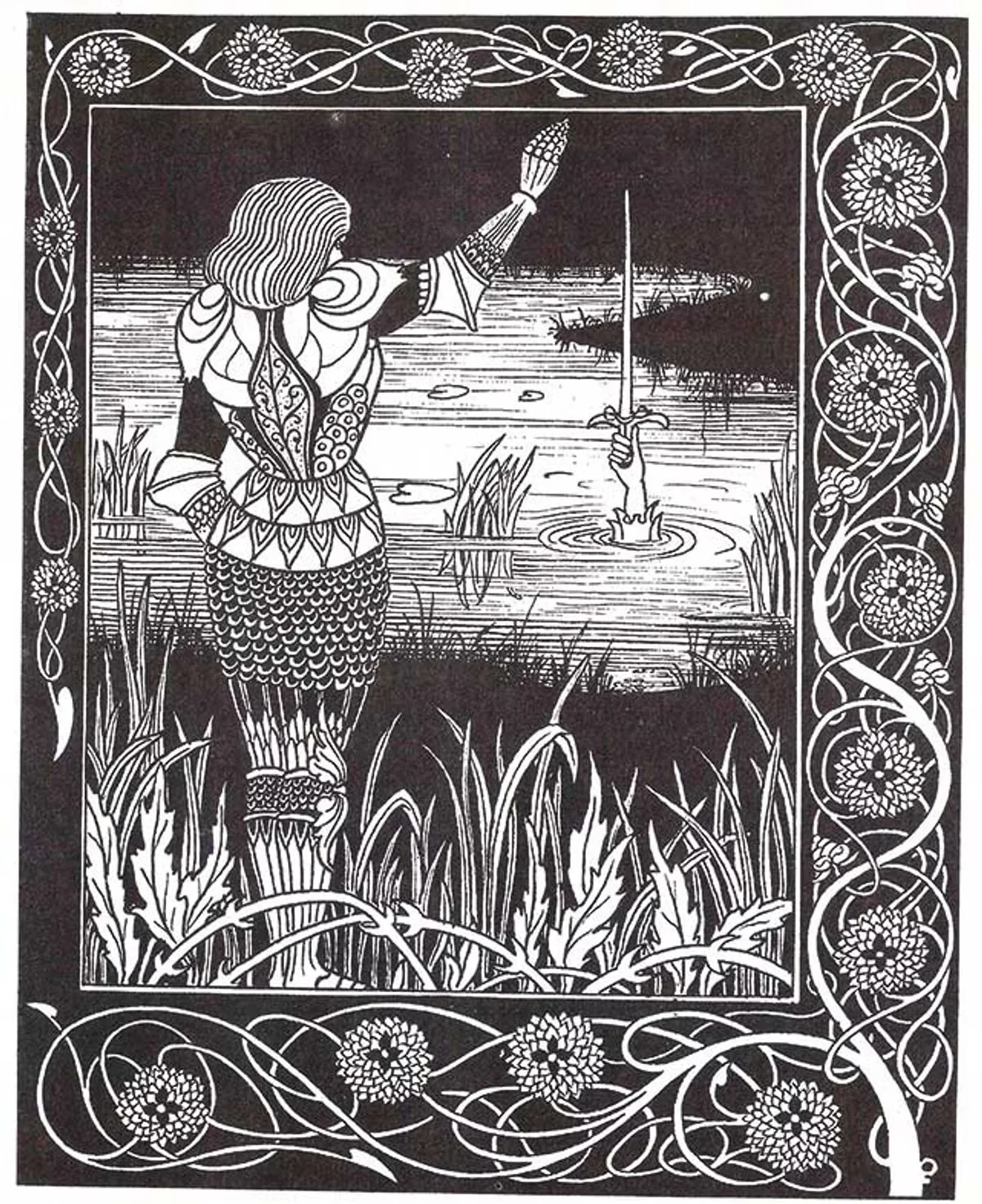 How Sir Bedivere Cast the Sword Excalibur into the Water, an illustration by Aubrey Beardsley (1893-94).
'Stairway to Heaven'
'Stairway' is another allegorical epic, and appears on the album immediately after the battle narrative. Straightaway, the song has an uncanny, slightly dated feel, with its iconic acoustic guitar and recorders mirroring traditional folk arrangements. At the time, it was one of many rock songs that received claims of back masking and containing satanic subliminal messages. Plant's cryptic lyrics about greed and wealth carry an undying mysticism that continues to be open to interpretation.
"There's a lady who's sure all that glitters is gold
And she's buying a stairway to Heaven
When she gets there she knows, if the stores are all closed
With a word she can get what she came for."
The song has a cynical opening, reflecting on a superficial optimism that is centred around the pursuit of wealth. There are further allusions to Tolkien ("all that is gold does not glitter"), which possess a cautionary tone. "Buying a stairway to heaven" thus symbolises being blindsided by greed, and forgetting what truly matters.
"There's a feeling I get when I look to the West
And my spirit is crying for leaving
In my thoughts I have seen rings of smoke through the trees
And the voices of those who stand looking."
In the succeeding lines, it becomes clear what Plant believes this is. Looking to the west again evokes Avalon, and the Undying lands to the west of Middle-Earth. It demonstrates a longing for an ethereal bliss that is lacking in the ordinary world.
The 'rings of smoke' connote a kind of Blakean Romanticism - "England's pleasant pastures" becoming "dark Satanic Mills". They lament the corruption of pastoral landscapes, as they lose their charm to the smoke of industrialisation.
"And it's whispered that soon if we all call the tune
Then the piper will lead us to reason
And a new day will dawn for those who stand long
And the forests will echo with laughter."
These lines draw on the tale of the Pied Piper of Hamelin, but instead of being the malevolent figure luring children to their deaths, here the Piper is prophetic of better times to come. He leads us away from money and other inconsequential things, instead towards a rebirth of shared understanding that becomes the 'stairway to heaven'.
During a live performance of the song, Plant followed up these lyrics by asking the audience, "does anyone remember...forests?" This unrehearsed ad-lib lends itself further to an eco-critical reading, urging us to become acquainted once again with the forests we have long forgotten.
"If there's a bustle in your hedgerow, don't be alarmed now
It's just a spring clean for the May queen
Yes, there are two paths you can go by, but in the long run
There's still time to change the road you're on."
As if in answer to the preceding lines, the song now fully kicks in with full band instrumentation, and completely embraces natural imagery in the lyrics. The 'bustle in the hedgerow' refers to the nest-making of birds, and thus the coming of Spring. In the wake of these new beginnings, Plant urges us to be open-minded, and consider alternative methods of fulfilment; we must not be started by new, unexpected ideas, but welcome them. Linking back to the Piper's road to reason, there is the continued hope of discovering new paths no matter where you are in life.
Ultimately, 'Stairway' is a reminder not to become so preoccupied with material things that we take the beauty of the world for granted. This seems like crass advice from a band with their own private jet, but the sentiment is important nonetheless...
'The Rain Song'
Moving onto their fifth studio album Houses of the Holy, 'The Rain Song' was written in response to George Harrison complaining that the band could't write ballads. Originally an instrumental piece called 'The Season', it is a gorgeous meditation on the cyclical nature of life and love - it is also one of my favourite songs ever written!
"It is the springtime of my loving
The second season I am to know
You are the sunlight in my growing
So little warmth I've felt before"
The song centres around a relationship, with the narrator reflecting on how barren his life was before. It captures the bloom of new endeavours - both the excitement and the naivety, and it even has a sexual tone in its imagery of plants growing. Plant was renowned for his ability blend mythical romanticism with sexual innuendo, and while some of his lyrics are often questionable, he does it in quite a tasteful manner here.
"These are the seasons of emotion
And like the wind, they rise and fall
This is the wonder of devotion
I see the torch
We all must hold
This is the mystery of the quotient, quotient
Upon us all, upon us all, a little rain must fall."
'The Rain Song' is another Zeppelin track that gradually builds, owing to their genius technique of bringing drummer John Bonham in halfway through the song. It transforms everything, while Page's lyrics showcase the mutability of the seasons and human emotions. Despite the passionate beginnings of this relationship, they will inevitably face hardships. However, Plant frames these experiences not as signs of failure, but as natural, and beautiful, and divine. The culminating lines have a stoic, mature tone far removed from the care-free sensuality of its opening - but though the rain must fall, this is what allows us to grow.
While the lyrics are not entirely in reference to any kind of mythology, their pastoralism speaks to themes previously discussed and links to a wider ethos in the band's psyche at the time. The title of the album Houses of the Holy is generally understood as a nod to the massive stadiums where band and fans alike would gather. However, there is potentially a more spiritual meaning behind it. Jimmy Pages has expressed the belief that the physical human body acts as a vessel - or house - for the soul. This song in particular sees humans as receptacles of feelings and experiences; we are able to be filled up with certain emotions, and likewise be emptied of them, or pour them out to others.
What's more, as part of the concert film The Song Remains the Same, the song was accompanied by a cinematic and plot-driven music video. We see Plant doing a number of knightly activities: walking through woodland; on horseback; arriving at a castle to rescue a damsel in distress; engaging in sword fight with her captors, and eventually saving the woman. It could be straight out of any medieval fantasy film, with Plant posing as the Arthurian knight-errant on a quest to prove his chivalry.
In simpler terms, the overall ideology of the song and album can be taken as such: humans contain the path to something higher within them, and it is only through going on some kind of quest - whether that be love or music - that we can achieve it.
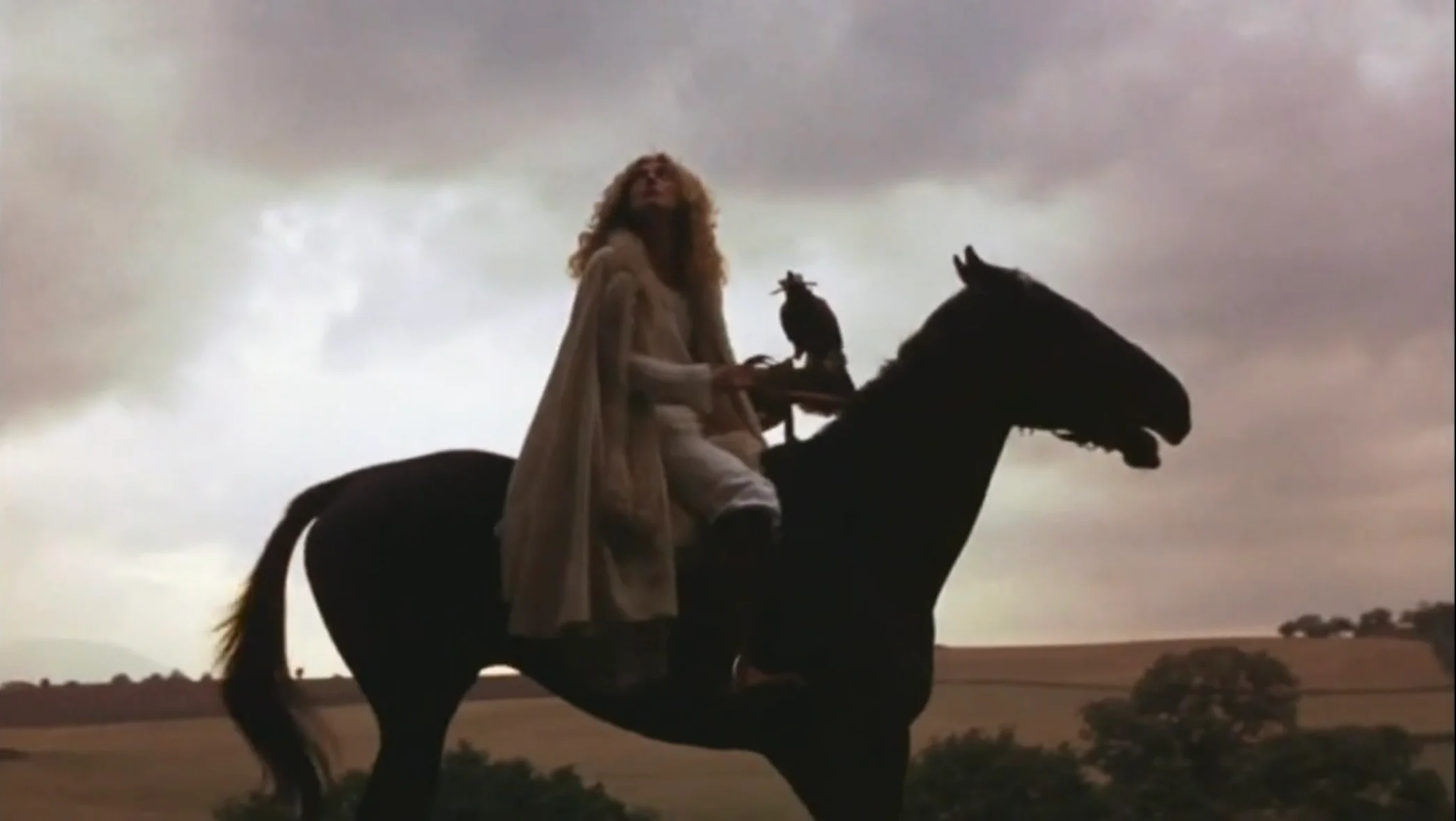 Source: The Song Remains the Same
After Led Zeppelin disbanded in 1980, Plant continued making music both by himself and with Page. He has collaborated with musician Alison Krauss on various country and bluegrass projects, and in more recent years has found himself returning to folk. Songs such as 'The May Queen', 'Little Maggie' and 'Up on the Hollow Hill (Understanding Arthur)' continue to use mythological topics (if only mentioned in the titles) to explore the full array of human emotions, from the most banal to the absolutely breathtaking.
Page's Occultism
While Plant's mysticism leans into pastoral appreciation and an overarching aim for unity, Page's interest lay more in the occult - the study of hidden knowledge and supernatural powers that lie beyond general human understanding. Since being a teenager he was obsessed with occultist and ceremonial magician Aleister Crowley.
While facing accusations of being a 'satanist', Crowley's practices were summarised by phrases such as "do what thou wilt" and "so mote it be", both of which were allegedly carved into the grooves of the vinyl for LZ III. Indeed, Page has stated his interest in the figure simply stems from a curiosity in "all things mystical and magical, all things bright and beautiful."
Page once owned a bookshop dedicated to Crowley's works, and at one point even bought his Scottish manor Boleskin House. The guitarist's spiritualism became so infamous that David Bowie supposedly has his house exorcised following a visit from him. Whether true or not, the dark ritualism surrounding his practices was responsible for a huge part of the band's artistic direction.
Symbols
In the place of an official album title for LZ IV, Page decided each member of the band should have their own personal symbol.
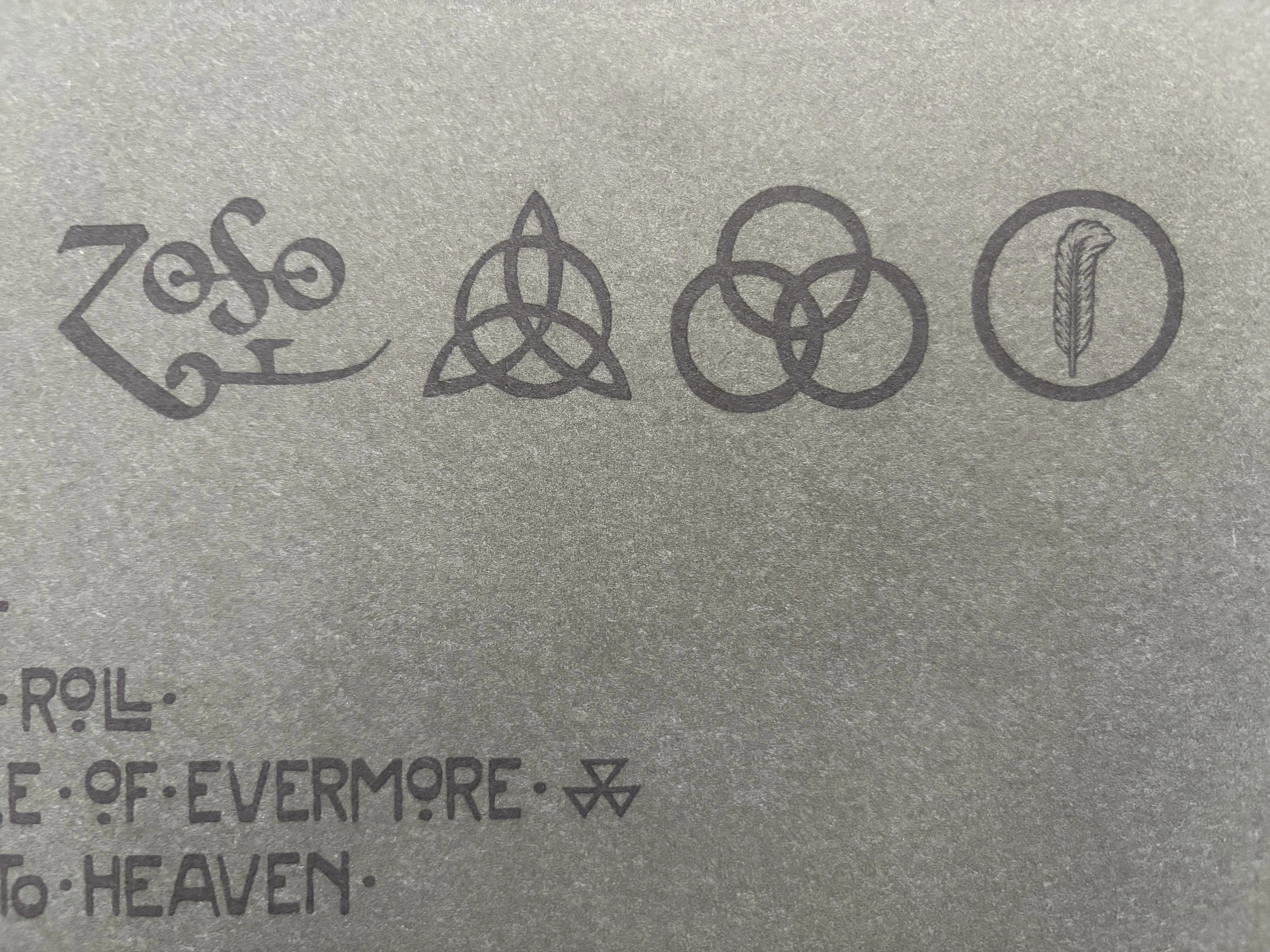 From the left: Page, Jones, Bonham and Plant. Image of the inner album sleeve via lozferatu.
John Paul Jones chose the triquetra, an ancient symbol used in Pagan and Norse art to denote the triple aspects of the goddess (maiden, mother and crone). Bonham's symbol depicts three interlocking circles known as Borromean rings, representing the trinity of mother, father and child. Plant designed his own symbol, an encircled feather denoting the ancient Egyptian goddess of justice; it can also be thought of as a quill, pertaining to Plant's role as chief lyricist.
For Page's symbol, he also took the design into his own hands, but the origins are a lot more nebulous. It is referred to as 'ZoSo', but the guitarist has never really disclosed any information about it. There are many theories, chiefly its resemblance to the alchemical symbol for Saturn. It has even been said that it has links to Tantric sexual experiences that bring people closer to the secrets of the universe. Regardless, it corresponds to this idea that higher truths are not readily accessible to all, but instead are achieved through great difficulty.
Tarot
The cover for LZ IV depicts a man hunched over, carrying a bundle of sticks. It was a real picture found by Plant in an antique book shop, but is also has a striking resemblance to the Ten of Wands tarot card of the Rider-Waite deck, illustrated by Pamela Coleman Smith.
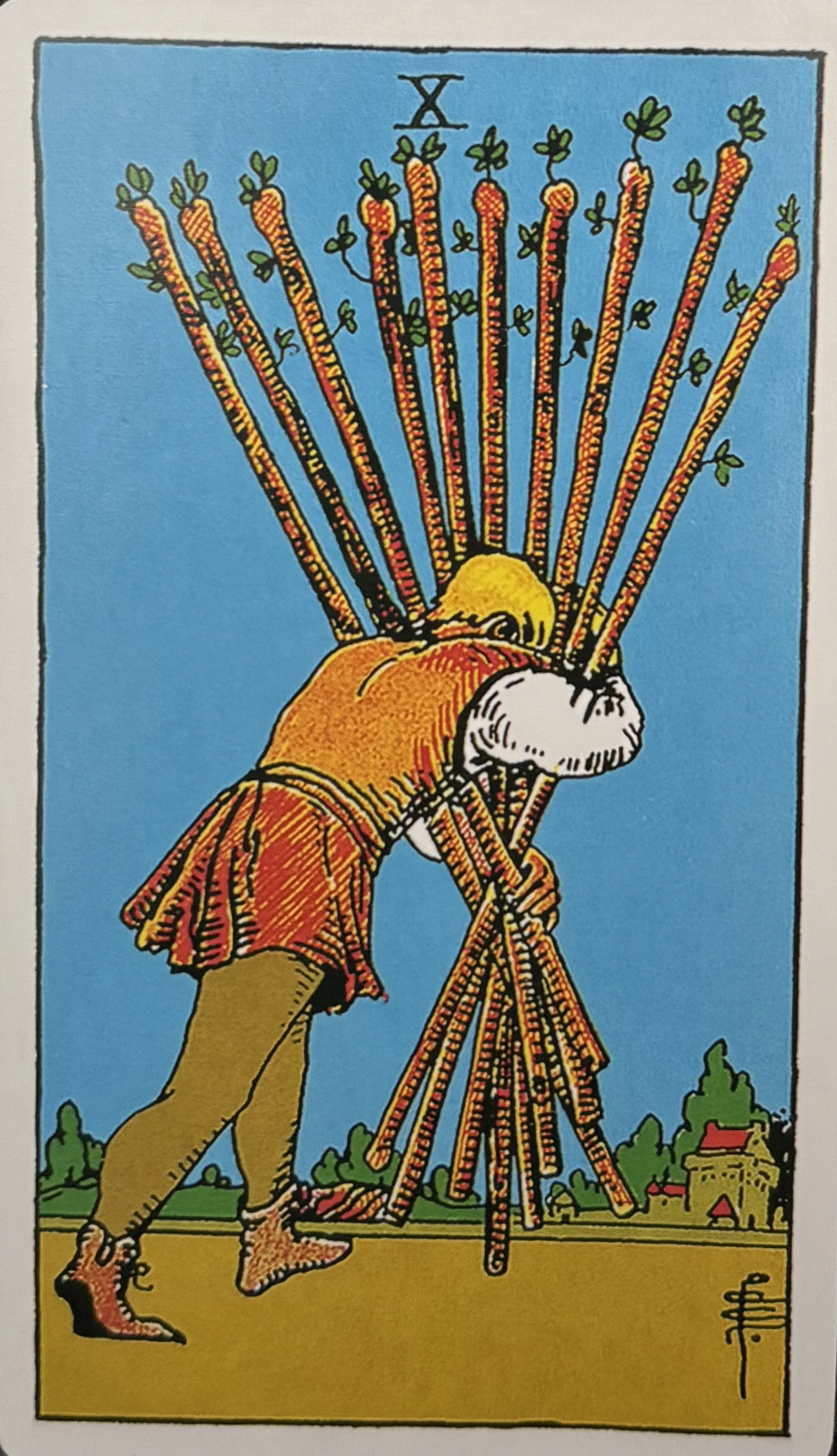 Image via lozferatu.
Within the minor arcana, wands are symbolic of energy and creativity. Although at first glance it seems the man is physically burnt out, his goal is in sight; it thus serves as encouragement not to give up at the final hurdle.
The back cover of the album displays a block of flats in Birmingham, a stark contrast to the rustic feel of the front. It speaks to an otherworldly presence creeping into ordinary, urban settings. In an interview, Page discusses this country/city dichotomy in more detail.
"It represented the change in the balance which was going on. There was the old countryman and the blocks of flats being knocked down. It was just a way of saying that we should look after the earth, not rape and pillage it."
Another card that featured within the album sleeve is The Hermit. Standing alone on a mountain top with a lamp to light his way, the Hermit calls for solitude and introspection in order to gain knowledge. Within the Fool's journey of the Major Arcana, it is the point in a journey where we must pause and look inwards. Page identified very closely with the archetype; he interpreted it as "a seeker aspiring to the light of truth", and its message can be seen in the band's retreat into the wilderness to work on music.
Like Plant, Page also has his own self-indulgent fantasy sequence in TSRTS. During the twenty-nine minute rendition of 'Dazed and Confused', we see a cloaked Page climbing the mountains surrounding Boleskin House, on yet another mythical quest. At the summit he comes face to face with the Hermit, and the elder's face morphs into that of Page.
The opposition between the burdened figure on the album cover, and the enlightened hermit within ties all these themes together - of journeys, toil, introspection and eventual enlightenment.
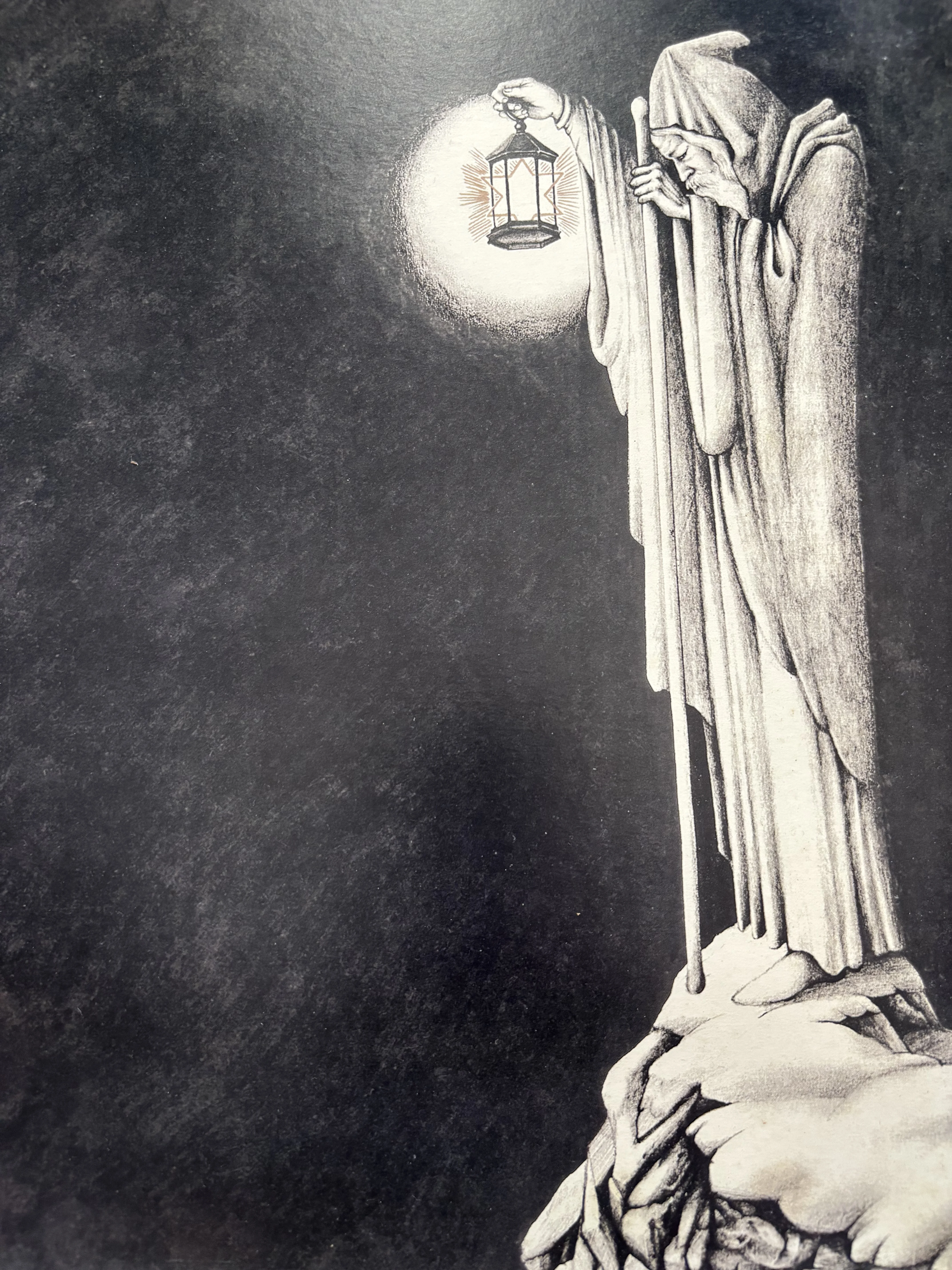 Image via lozferatu.
Like the enduring myths they draw on, the rock gods utterly transcend time. By inhabiting these worlds steeped in folklore and mythology, they continue to mystify well into the twenty-first century.