 Source: IMDb
(For the full essay version of this article, check out my Substack).
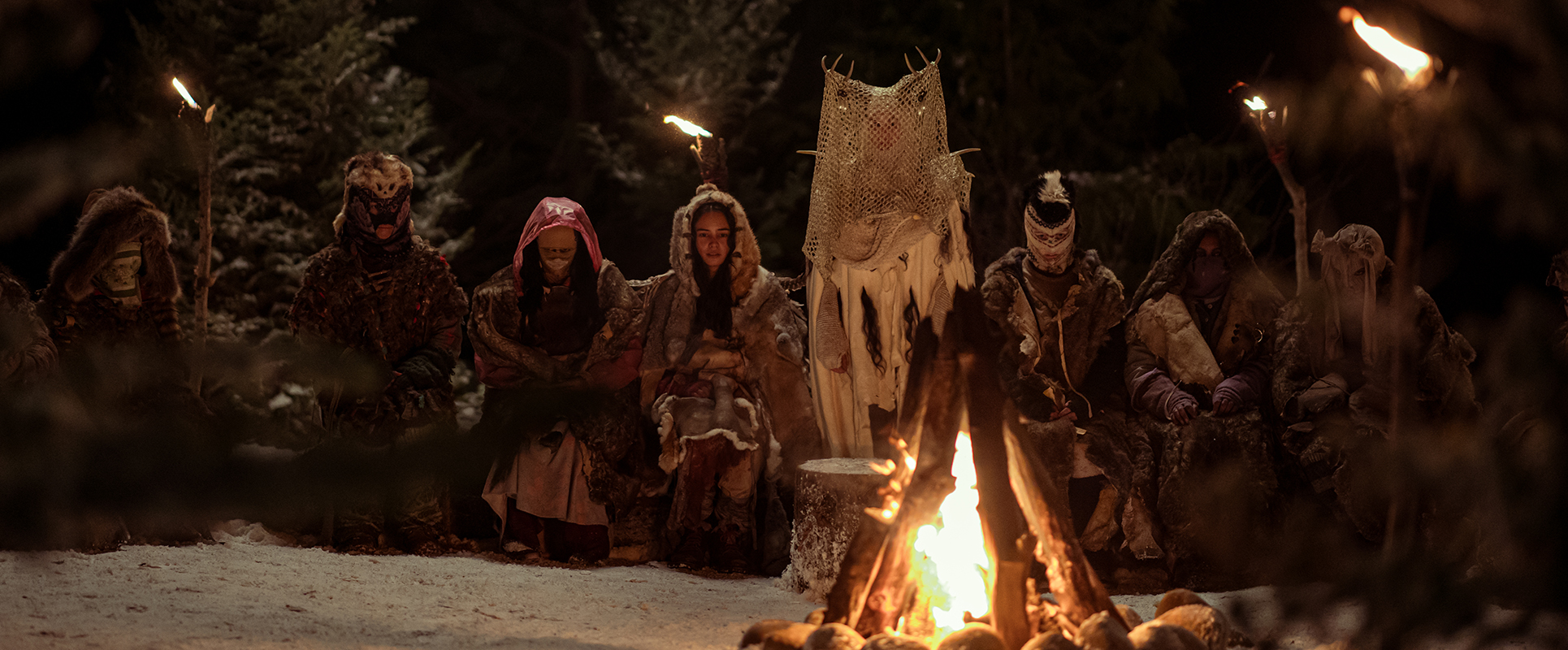
It’s been fifty-four years since Robin Hardy's The Wicker Man - hailed ‘the Citizen Kane of horror films - hit cinema screens, but it remains just as enigmatic today. The cult classic follows the stiff, dedicated Christian Sergeant Neil Howie (Edward Woodward) on his investigation into the disappearance of Rowan Morrison (Gerry Cowper) on the Scottish Isle of Summerisle. As Howie's investigation continues and the villagers deny the existence of the girl, his suspicions about their true intentions grow. The film climaxes with a misled Howie thinking he has rescued her from human sacrifice, when in actual fact (SPOILERS) their plain was to sacrifice him in hopes of a better harvest.
The film's blurring of the lines between sex, religion, identity and culture is one of the main reasons it has remained so unsettling; Paul Giovanni/Magnet’s soundtrack is an integral part of that. From the Scottish/Pagan influences of ‘Corn Rigs’, to the mesmeric and sensual elements of ‘Willow’s Song’, the soundtrack forms the basis of the film's mystery and horror.
The American musician Paul Giovanni directly uses some older British folk songs. The finale song ‘Sumer Is Icumen In’ is actually the oldest known British composition, believed to have been written in the 1200s by a monk called William Winchester,
known for his sexual promiscuity. On the surface it can be an innocent song about regeneration and new life, but is menacingly twisted by Giovanni when used in the final scene, sung sadistically by the villagers as they circle Howie’s sacrifice. The song is also rumoured to be about adultery, further complicating the relationship that TWM has with sex and death.
Writer Allan Brown claims that one of the interesting things about TWM is its "inversion of the relationship between sex and death, [because] we know in horror films that sex leads to death" (Brown, Inside the Wicker Man: How Not to Make a Cult Classic, 2010). As it turns out, Howie could have been saved by having sex with the landlord’s daughter Willow (Britt Ekland).
Willow is dubbed "the goddess of love in human form", quoting Walt Whitman's poem about Aphrodite. There is this worshipping quality to the way the village view her. In the bawdy pub song ‘The Landlord’s Daughter’, sung predominately by old men, they name her "a baggage that we all adore". There is another duality here - the bawdiness in naming her in such misogynistic and degrading terms, whilst praising and ultimately objectifying her.
‘Willow’s Song’ also carries this weight, acting as a premonition of something negative. Howie has no problem with Summerisle's predatory offering of young men to Willow, but is quick to vilify her for her sexual expression. The song's two final couplets are taken from various verses originating from Elizabethan poetry ,
conjuring again this cyclical idea of life and sex throughout history. The island's culture and religion is deeply rooted in the pre-Christian ideas Howie condemns, and in his various attempts to erase their teachings, he becomes a coloniser."Fair maid, white and red
Comb you smooth and stroke your head
How a maid can milk a bull!
And every stroke a bucketful"
The referencing doesn’t stop there: "I’ll catch a rainbow from the sky and tie the ends together" is a sultry twist on ingrained, well known Christian imagery. Here, Willow is tying together her perspective on reproduction with that of Howie’s. The musicality extends to the dance sequence, in which she tries to get Howie's attention. Willow is definitely an oversexualised figure, but there is an also an autonomy within that.
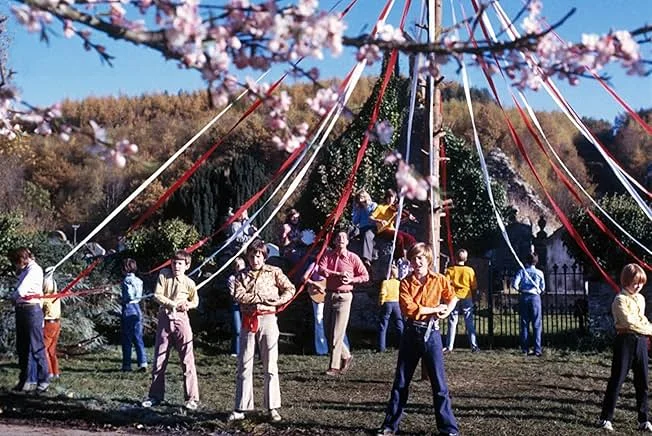
Throughout the film, sex is something that Howie abhors. Giovanni’s layering of the children's harmonies in ‘The Maypole Song’ carries both a sinister and educational tone, reflecting what they are being taught. Sex and sexual reproduction make up a fundamental part of their education, and the duplicity of Summerisle lies in its ability to challenge our own deep-rooted prejudices. Are we in discomfort because the children are learning about sex? Why is that? Why shouldn’t they learn about reproduction as something linked to the natural world? 'The Maypole Song' perfectly exemplifies this through its harmonies, cyclical lyrics and instrumentation - particularly the use of a jaw harp. This unusual instrument evokes familiarity and community, with an undertone of something that just feels, well - off.
Elsewhere, the soundtrack invites a queer reading of the film. Giovanni himself was queer and dating TWM's screenwriter Anthony Schaffer’s brother at the time. Many critics have argued that the film is a metaphor for Howie’s own repressed homosexuality, and that interpretation can be seen in my favourite song from the film - ‘Gently Johnny’. The song is sung in the pub by Giovanni himself on the night of Howie's arrival. The call and response nature of the song captures a sense of caution and respect between two partners, leaving room for a queer reading. It has a hypnotic tone, owing to its build up of instruments throughout. Giovanni's voice is accompanied by simple acoustic guitar and a methodic drum beat, perhaps emphasising expression as a fundamentally necessary thing.
The song underscores a monologue from Lord Summerisle (Christopher Lee):
"I think I could turn and live with animals. They are so placid and self-contained. They do not lie awake in the dark and weep for their sins. They do not make me sick discussing their duty to God."
There’s a lot to unpack here. Upon initially hearing ‘animals’, it could be associated with a more primal existence. However, Summerisle twists expectations by naming them as ‘placid and self contained’, demonstrating a comfortability with one's self and identity. Lee's previous roles in Hammer Horror films have a masculine presence, but also a kind of camp androgyny. With this in mind, we can see these qualities in Summerisle. The imagery of weeping in the dark seems, by proxy, reminiscent of gender and sexuality and the struggles that come with accepting that.
Returning to 'Gently Johnny', the lyrics could portray a hesitancy within a heterosexual relationship due to these repressed feelings. As it underscores Summerisle's speech, it arguably foreshadows Howie's fate, and the danger of not embracing one's queer identity.
The Wicker Man has become one of the most iconic pieces of cinema in the last sixty years, and the soundtrack allows this psychological horror to be properly explored. Its mellow and hypnotic qualities elevate it from being an engaging and creepy horror film, to a cinematic masterpiece.