 Source: The Guardian
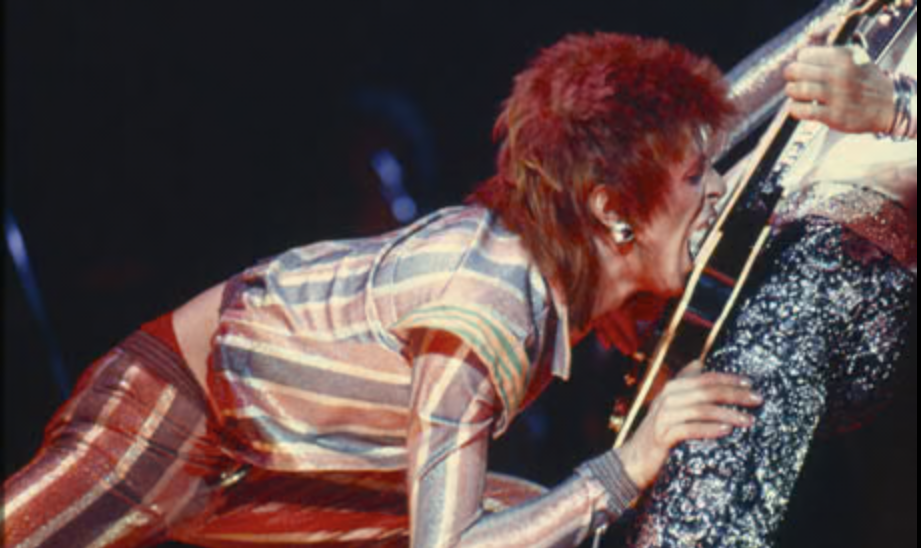
David Bowie’s 1972 concept album The Rise and Fall of Ziggy Stardust and the Spiders from Mars, is one of the most defining albums of the glam rock era. It explores themes of sexuality, stardom and impending apocalypse, with Bowie’s alter-ego Ziggy Stardust - an amalgamation of his various influences such as Vince Taylor, Marc Bolan and Iggy Pop - propelling him into stardom as one of the most influential British musicians of the 20th century.
My personal highlight on the album is 'Suffragette City'. Influenced by the proto-punk of The Stooges and The Velvet Underground, as well as the 50s rock ‘n’ roll music of Little Richard, the song narrates a conversation between Ziggy and his friend Henry:
“(Hey man) Oh, leave me alone, you know/ (Hey man) Oh, Henry get off the phone, I gotta/ (Hey man) I gotta straighten my face/ This mellow thighed chick just put my spine out of place”
It’s clear that Ziggy is shutting out his friend Henry to have sex with this woman; it can alternatively be read as alluding to his bisexuality. Henry’s craving for Ziggy’s company, illustrated through his repetitive cry of "Hey man" throughout the first and second verses, could suggest that he was a sexual partner of Ziggy and is trying to return to him. This would not come as a surprise, due to Bowie’s homoerotic lyrics throughout the album, as seen in other songs like 'Moonage Daydream' (“pink-monkey-bird”, being a recipient for anal sex). Furthermore, “straighten my face” could be a playful joke made by Bowie about his shifting sexuality, mirroring that of the narrator’s.
In the chorus, Bowie and Mick Ronson both sing:
“Oh, don’t lean on me man, ‘cause you can’t afford the ticket, Back from Suffragette City”
Although it’s Bowie and Ronson singing, Ziggy is the one saying it. Peter Doggett acknowledged that prior to Bowie’s song, the only popular song to contain the word ‘Suffragette’ was 'Sister Suffragette', featured in the 1964 musical film, Mary Poppins. He argues that the musical number has more to do with women’s liberation than Bowie’s punk predecessor. Instead, 'Suffragette City' is a nickname for Manchester, a key location in the Suffragette movement. In this catchy hook, Ziggy is encouraging Henry to become more individualist and adjust to the new world. He does the by threatening to take him away from London, the centre of the British glam rock scene, and send him back into northern obscurity.
Another interesting characteristic of 'Suffragette City' is the variety of pop culture references embedded in the song. Bowie, who was influenced by Anthony Burgess’ 1962 novel A Clockwork Orange, includes references to the fictional Nadsat dialect:
“(Hey man) dear droogie, don’t crash here/ There only room for one, and here she comes, here she comes”
Bowie employs the phrase “droogie” (friend), in the second verse to allude to Burgess’ dialect, which is heavily used by the youth subculture in his novel. Bowie's use of it in the song further emphasises Ziggy’s hedonistic lifestyle and attitude; he’s pursuing pleasure through shutting out his friend, and instead indulging in sex and drugs. In the outro to the song, the pop culture of the 1950s is also mentioned through Bowie’s shout of:
“Oh, wham, bam, thank you, Ma’am!”
This phrase was popularised in music as the title of a Dean Martin song in the 1950s, which explores heartbreak. In this song, however, Bowie gives it an explicitly sexual meaning, displaying Ziggy’s height of pleasure and coming to signify a sexual encounter that doesn’t require any further commitment. Bowie’s use of the phrase in the song not only further popularised it, but also echoed the rhythmic yell in the opening of Little Richard’s 'Tutti Frutti', a song which originally had explicitly sexual lyrics (“Whop bop b-luma b-lop bam boom!”).
Although three-and-a-half minutes, 'Suffragette City' is more than a simple rock song written in Bolan-esque gibberish - it is a story about hedonism, stardom and sexual pleasure. The album itself further reflects not only on the music of the past, through Ziggy Stardust’s character, as well drawing on elements of garage rock, jazz and soul; it also looks towards the future, inspiring many post-punk, indie and punk rock artists.
This clairvoyant outlook is pushed further through the prophecies embedded in Bowie’s other songs. 'Five Years' opens with a warning about an apocalypse, signalling the end of the glam rock era in 1977; the choppy Cochran-inspired guitar in 'Hang On to Yourself' directly echoes the punk records of Sex Pistols and Ramones, and Stardust’s call to Earth’s youth through a radio in 'Starman' came to influence many of Bowie’s descendants, such as Siouxsie Sioux, Morrissey and Boy George.