 Image via JakeDivision
This is one I was nervous for in all honesty. Hometown gigs will always matter more to all those involved, that’s a fact. Whether it's the artist themselves, those in the crowd, or family and friends, a gig in your own backyard must have a different feeling. Any arena can be conquered, festival crowds can be won over, but a hometown show carries something unspeakably heavier. History, expectation, pride. Thousands upon thousands of people who feel some tiny degree of ownership over those standing upon the stage through pure coincidence of being born in the same city. So, strangely, I spent much of the build-up to Courteeners’ headline show at Wythenshawe Park feeling unusually nervous for them in a way I can never fully explain. Seeing Courteeners in Manchester is nothing new to me, but there are so many reasons why playing Wythenshawe could be conceived as a greater deal for the lads from Middleton than previous gigs in the city.
Live From Wythenshawe Park Festival had already welcomed artists who, by conventional measures, are bigger. By the time Courteeners took the stage on this iteration of the festival, The Cure, Pulp, and Lewis Capaldi had all been there, and The Prodigy were scheduled as the Sunday headliner. But the Saturday night of August Bank Holiday weekend belonged to Manchester. More specifically, it belonged to a band whose songs have been shouted back at them in pubs, bedrooms, student houses, festival campsites and sweaty venues across this city for nearly two decades.
Perhaps that’s why this one felt different. Courteeners have sold out the larger Heaton Park on no less than three occasions, turned Old Trafford Cricket Ground from the scene of a peaceful sport into an arena of chaos twice, and had both the AO and Co-op arenas packed to the rafters. Five night run at the Apollo? Completed it mate. But whether or not they could replicate these atmospheres on the opposite side of town in the shadows of the legends who stood on the same stage just hours beforehand was something I wasn’t fully confident of. The joke was, however, firmly on me - I had no reason to be worried.
Liam Fray himself clearly understood the significance of a home town gig. In the build-up to Wythenshawe, he returned with the BBC to The Britons Protection, the iconic Manchester pub where he played some of his earliest shows more than twenty years ago. He reminisced about oversold rooms, old antics around the city and the surreal fact that songs once written in his parents’ garage are still being discovered by new generations. “It’s mad that it’s been 20 years,” he admitted, while reflecting that those songs no longer really belong to the band at all, but to the people singing them back. On his own Substack, Fray had also described finding himself nervous about the smallest details surrounding Wythenshawe, things that might barely register before another show suddenly carrying enormous importance. For all the gigs Courteeners have played and all the crowds they have stood in front of, Manchester still appeared capable of making their frontman feel the weight of the occasion. Perhaps that was reassuring. The night mattered more to us because the songs were now ours. Evidently, it mattered more to him for much the same reason.
Maybe my nervousness had something to do with my own history with Courteeners. To me, they belong to a version of my life that is beginning to feel just that little bit distant: teenage gigs, getting as close to the front as physically possible, mosh pits, bad decisions and the unquestioned belief that the only correct way to experience a concert was to leave it absolutely shattered. I’m in my mid-twenties now. That version of me hasn’t at all disappeared, but he no longer makes all the decisions.
Courteeners themselves are in a period of change. Their latest record, Pink Cactus Café, steps away from some of the immediacy that made their earlier material so irresistible, sounds increasingly comfortable with reflection, restraint and growing older. Standing in Wythenshawe Park, I realised that my relationship with them has changed for much the same reason. My teenage years are firmly behind me now. The desire to spend an entire gig fighting my way towards the front, disappearing into a mosh pit and emerging drenched in my own sweat and somebody else’s lager is slowly diminishing. The love of being there, however, hasn’t and likely never will. As Courteeners came home to Manchester on Saturday night, I found myself wondering whether growing alongside a band might be one of the great privileges of loving music in the first place. Courteeners are no longer the band I first fell in love with, and I am no longer the person who first fell in love with them, but old parts of us both are still completely present.
If Courteeners themselves are now caught somewhere between who they were and who they are becoming, the crowd at Wythenshawe Park seemed to contain almost every stage of that journey at once, and it was beautiful. Glances in certain directions revealed wholesome scenes of children clung to parents, families sat together on the grass as fairground rides spun away behind them. At times, the atmosphere was remarkably pure: the sort of Bank Holiday afternoon where somebody's dad produces sandwiches from a backpack and everyone agrees to meet back at the same spot if they get separated. Glances in the other direction showed different stages of life: younger lads already treating the park as though Courteeners had started playing three hours early, bouncing around, displaying several of the traditional visual indicators that their afternoon may have involved a little more than just overpriced San Miguel. It was Manchester's circle of life laid out across one enormous field: children attending their first gigs while, elsewhere, somebody's nineteen-year-old appeared determined to experience several gigs simultaneously.
It would have been easy to see a divide between them: sensible adulthood on one side and youthful chaos on the other. Instead, I increasingly found myself looking at it as a timeline. Even the music between acts seemed to understand what was happening. Barry White drifted across Wythenshawe Park at one point, along with The Stone Roses, ABBA, and Fontaines D.C. Different generations, different moods and different ideas about what constituted a good afternoon were all being asked to share the same patch of Manchester grass, and it worked perfectly.
Music has a strange habit of making the journey disappear, regardless of if I’m watching an acoustic set in a local pub, a headline act at a festival in a foreign country or if I’m striding into Wythenshawe Park. There were four support acts across the day, although my own plans were considerably less ambitious. I had aimed for the final two, and despite the inevitable issues with our Andy’s big yellow buses proving that getting to a gig can occasionally feel more complicated than the gig itself, I timed my arrival almost perfectly.
As I walked through the gates, The Coral were a couple of songs into their set and just beginning ‘In the Morning’. After the trams, connections, crowds and the usual low-level anxiety that accompanies trying to get tens of thousands of people into one place, there was something strangely fitting about arriving to a song built around the sense of emerging into a new day — of moving “out of the dark and into the light.” The journey was suddenly over; whatever frustrations had come before were left outside the gates. From that point on, there was only the music.
Tracks like 'In the Morning' and 'Dreaming of You' being belted out in a field no longer felt particularly tied to one era. They simply belonged there, carried forward by an audience containing people who remember them arriving, and others like myself who were barely born when they did.
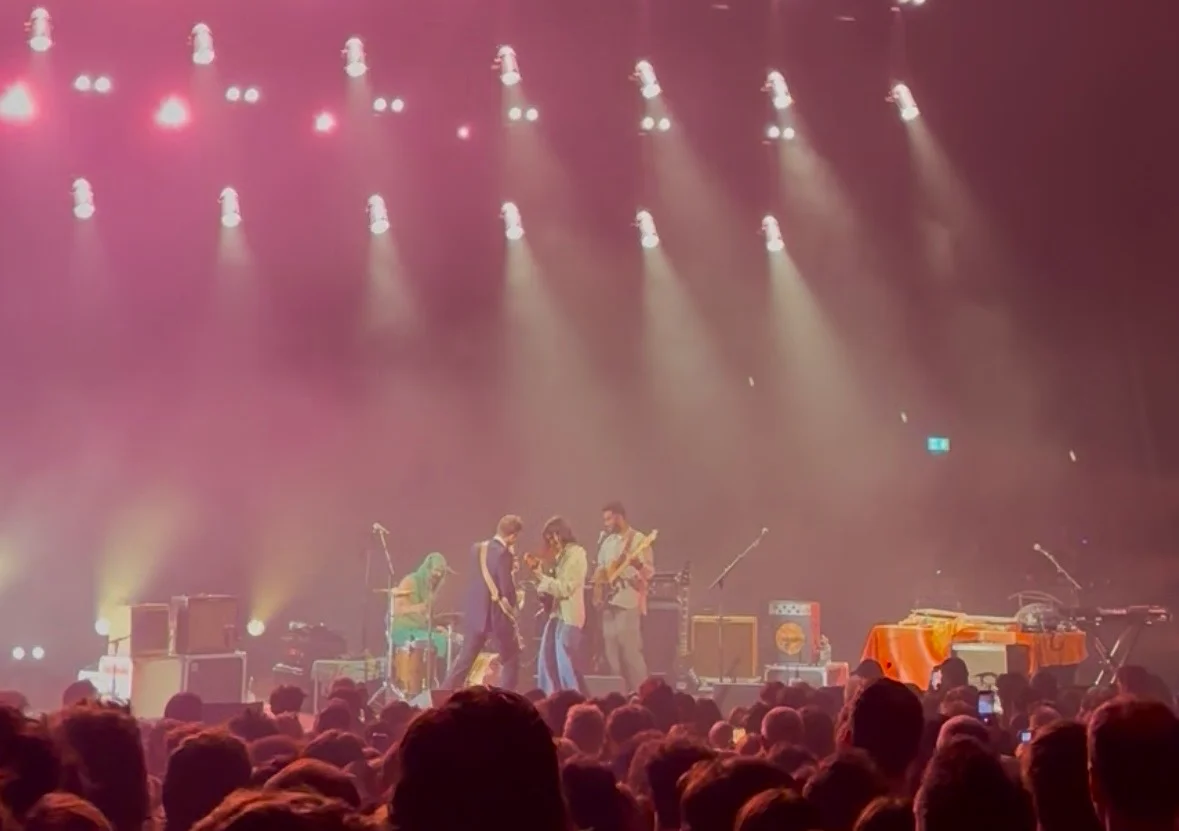
The Vaccines took that relationship with the past considerably further. Having seen them several times during this summer’s festival season, I already knew they were playing extraordinarily well. Wythenshawe might have been the strongest example yet. In an unusually generous move for a support slot, they performed their debut album What Did You Expect from The Vaccines? in full before dipping elsewhere into their catalogue. There was obvious nostalgia in hearing that record played from beginning to end, but nostalgia did not feel like the enemy here. That distinction would become increasingly important as the evening continued. Growing that little bit older with music does not mean endlessly chasing the feeling you had when you first heard it. Sometimes it means returning to the same songs with years of additional life attached to them and discovering that their implied meanings may have changed simply because you have. The Vaccines made an old record feel completely, but differently, immediate again.
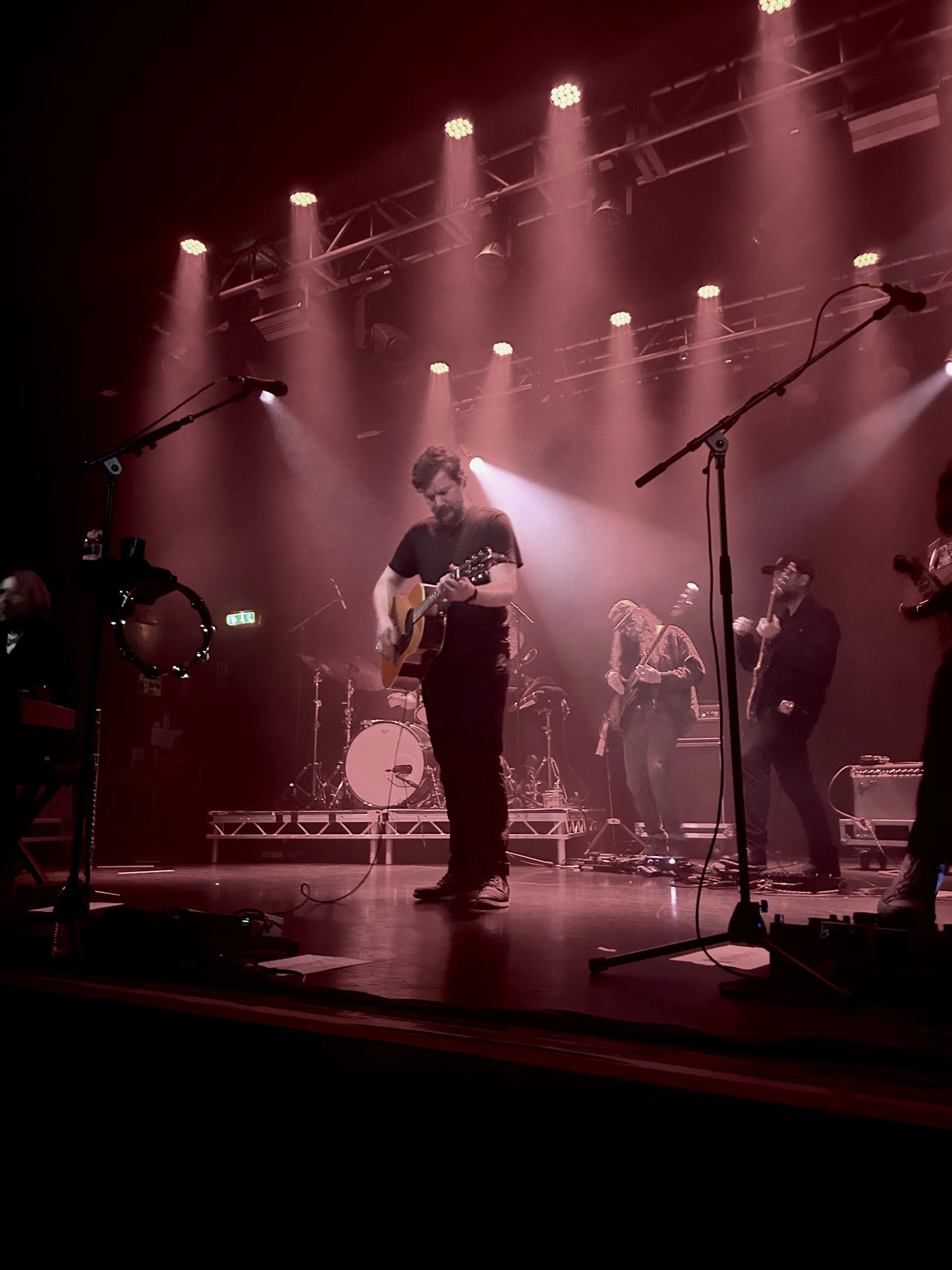
A little later, Courteeners would achieve something similar on a much larger scale, balancing the songs that made thousands of people fall in love with them against the music of the band they are naturally becoming. When Fray and company finally appeared, they did so with a choice that felt almost too perfect. The subdued opening notes of 'Sweet Surrender' felt like a soft but important statement. It would have been easy to start with something safer, something guaranteed to send the front half of Wythenshawe Park into chaos within seconds. Instead, they began with the present.
'Sweet Surrender' comes from the band’s newest album, and as the album opener it plants a comfortable seed of departure from the youthful urgency on which much of Courteeners’ reputation was built. It is softer around the edges, more reflective and far less concerned with pretending nothing has changed. Even the first words Fray spoke into the microphone seemed to acknowledge where Courteeners had come from whilst looking forward.
The opening line of 'Sweet Surrender' is a deliberate nod to 'Fallowfield Hillbilly', one of the defining songs of Courteeners’ earliest years. It felt fitting: the first sound of this newer version of Courteeners immediately reaching back towards the band they used to be. Change, once again, without abandonment.
“Another Rottweiler in the crowd says, can she even play guitar?”
Then came 'Are You In Love With A Notion?', immediate and unapologetic. For years, this track has occupied a similar role to 'Sweet Surrender'. It has long been a set opener, a statement of intent, the kind of song designed to instantly throw a crowd into motion. Now it arrived second. Perhaps I was reading too much into it, but standing towards the back of Wythenshawe Park, the order felt deliberate. The new Courteeners came first. The old Courteeners were still there, only a few minutes behind.
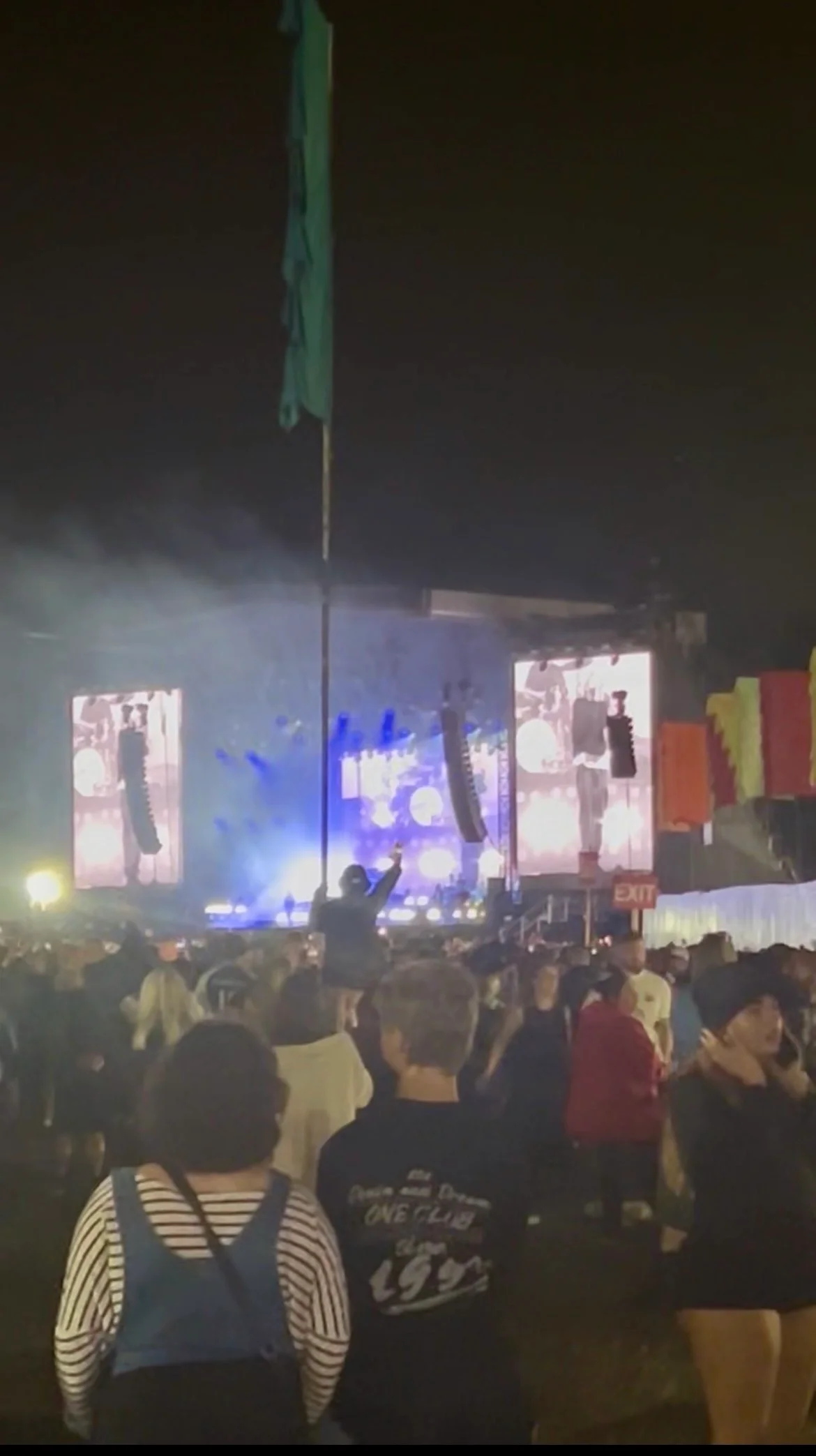
I’d deliberately positioned myself much further back in the field than I’ve ever watched a Courteeners’ gig prior. From where I stood, I could see almost everything. The lights stretched across the park, the stage seemed distant and somewhere towards the front, thousands of bodies moved as one. Every so often, a pocket of younger lads erupted into a mosh pit with the kind of enthusiasm I recognised immediately. Maybe on another night I would have wanted to be in the middle of it. This time, for the first time, I felt perfectly happy where I was. There was no sense of missing out, quite the opposite. Standing back allowed me to see the entire thing rather than simply survive it. I could watch the crowd, listen properly and appreciate the small details that become impossible to notice when your primary concern is keeping your feet beneath you. And somewhere in that change of perspective, the title of the opening song began to feel increasingly appropriate.
Maybe surrender does not always mean giving something up. Sometimes it means accepting that something has changed and discovering that what replaces it can be just as good. That is what 'Sweet Surrender' came to mean to me by the end of the night.
Looking back, this mindset may in part come from past experiences: times when I’ve straight up refused to surrender as my favourite artists have deviated from their origins. In 2018, Arctic Monkeys released Tranquility Base Hotel & Casino, and seventeen-year-old me wanted absolutely nothing to do with it. I was in sixth form college at the time. One of my clearest memories of its release is sitting in an A-Level Economics class, discussing the album with classmates who had also listened before the lesson started. We were united in disappointment; this was not what Arctic Monkeys were supposed to sound like in our heads. At least, that was how it felt then.
The Monkeys had moved dramatically away from the sound of AM, exchanging enormous riffs and urgent choruses for lounge pianos, science-fiction imagery and something far stranger and more restrained. We wanted the band we already understood. They had apparently decided to become somebody else. Today, it is one of their records I return to most. I sometimes wonder whether there is a tendency to describe that process as an album “growing on you”, when occasionally it is the listener doing the growing. Tranquility Base did not gradually become more relevant to my seventeen-year-old self. I simply became older than him.
Pink Cactus Café has occasionally reminded me of that record. Not because the two albums sound remotely similar, but because of what they represent for the bands that made them. Both are moments where an established group appears willing to step sideways from the version of itself that audiences have become comfortable with. The difference is that this time I never found myself wishing they would turn around.
I can hear things in Tranquility Base now that I simply could not connect with at seventeen. That is not at all because I understand music any better. Certain themes of reflection, melancholy, absurdity and ageing naturally make more sense when you have moved that little bit further away from adolescence yourself after discarding them first time round.
That is why Pink Cactus Café feels so significant to me. It represents a similar act of evolution for Courteeners. This is not a band desperately trying to recreate the exact conditions that produced St. Jude. They are older musicians making music informed by being older musicians. And this time, I am ready to go with them. I did not spend months wishing Pink Cactus Café sounded more like the Courteeners of my teenage years. I loved the departure almost immediately. Perhaps Tranquility Base taught me something without me realising it. You can spend years demanding that the bands you love remain exactly where you left them. Or you can surrender.
Opening with new material may have announced where Courteeners are now, but the set that followed made it very clear that they had no intention of pretending the journey there had not happened. Instead, Courteeners pulled freely from across their catalogue, delivering the sort of set that reminded you just how many different roles their songs have come to occupy over the years.
Some songs still exist primarily to cause chaos. 'Cavorting' and 'Acrylic' produced the familiar forward surges, thousands of people instinctively compressing towards the stage as though almost two decades of Courteeners gigs had established some unwritten choreography. Others belonged to everybody; 'Summer' and 'Bide Your Time' in particular became the enormous communal singalongs you would expect, tens of thousands of voices temporarily doing most of Fray’s work for him.
Then came the moments I have always loved most. Courteeners are often associated with swagger, bouncing crowds and pints launched into the air, but some of their most powerful live moments happen when they strip all of that away. 'The 17th' and 'Hanging Off Your Cloud' brought a completely different atmosphere to Wythenshawe Park, slower, more reflective and somehow capable of making a field full of people feel smaller. Standing at the back, those were the moments where time seemed to fold in on itself. A melody would arrive and with it came another memory: another year, another gig, another person. That is perhaps the strange privilege of having loved a band for long enough. Their songs gradually become less like individual pieces of music and more like landmarks where you remember what happened around them.
In the same way as these older songs pulled me backwards, one newer single in particular achieved the complete opposite. 'Solitude Of The Night Bus' is my favourite track on Pink Cactus Café, and hearing it at Wythenshawe Park felt particularly special. Courteeners’ vast back catalogue meant that this inclusion was far from guaranteed on the setlist, making its appearance all the more special to me.
My relationship with live music these days involves almost as much movement as it does standing in front of stages. Love of the festival season as an entity has increasingly meant travelling around the UK and across Europe, piecing together trains, flights, coaches and unfamiliar public transport in pursuit of another band in another city. Frequently, I make those journeys alone and I have come to love them. 'Solitude Of The Night Bus' thus seems to resonate perfectly.
“Wrapped up on the twenty past ten
Happiness is this warm fuzz
This is the solitude of the night bus.”
Few lyrics on the new album resonate with me more.
There is a very specific warmth to that moment for me. The gig is over, the logistics have finally worked themselves out and you are moving again, sitting quietly while everything you have just seen continues replaying in your head. The destination might still be a fair distance away, but for a while there is nowhere else you particularly need to be. Sometimes that means headphones on whilst watching an unfamiliar city disappear through the window, but solitude on any journey like this is rarely complete. “Sorry mate, you alright boss?”, perhaps an insignificant little lyric on my first couple of listens, later became another moment that aptly highlights these journeys I have become straggly fond of. Those tiny encounters. A conversation at a bus stop. Somebody asking which platform they need. A stranger still wearing the same festival wristband days after, prompting a conversation before boarding different trains and never seeing one another again. These are anything but insignificant and become part of a larger memory.
Years ago, I am not sure I would have understood why Fray would write a song about something so seemingly uneventful. Now it was one of those songs I was hoping for the most. Maybe that is the clearest sign of how much my relationship with Courteeners has changed. The old songs at Wythenshawe Park carried me towards people and places from my past. 'Solitude Of The Night Bus' required no such journey. It met me exactly where I am.
By the time the lights came up over Wythenshawe Park, I realised that 'Sweet Surrender' had become about far more than the song Courteeners happened to open with. This was a night built around looking backwards without being trapped there. A Manchester band returning home, still capable of sending fans crashing into one another to the songs that have done the same to me, but equally comfortable showing us where they want to go next. Maybe that is what sweet surrender really is: not giving up the things you love, but allowing them, and yourself, to change.
God bless the band.